
Something shifts after a brain injury. Not always in an obvious way. The person may hold a conversation without difficulty, explain what they want, and present as entirely capable. Then the decision comes. Signing a document, agreeing to a care arrangement, making a financial choice. Something breaks down between what they said they understood and what actually happens.
Families notice it first. A solicitor leaves an appointment uncertain, or a care manager flags something they cannot quite name. The Mental Capacity Act 2005 gives you a framework for understanding what you are seeing. The signs that a brain injury may affect mental capacity are specific, recognisable, and grounded in law. Knowing what to look for is the starting point for getting someone the right support.
What the Mental Capacity Act Tests
A brain injury does not automatically remove someone’s right to make decisions. The Mental Capacity Act 2005 is clear on this: every person must be assumed to have capacity unless it is established that they do not. A diagnosis, on its own, is not enough.
Section 2 of the Act sets the diagnostic threshold. Capacity may be affected where there is an impairment of, or a disturbance in, the functioning of the mind or brain. A traumatic brain injury meets that threshold as a condition. But meeting the diagnostic threshold is only the first part of the legal test.
Section 3 requires four things. The person must understand the information relevant to the decision, retain it long enough to reach a conclusion, use and weigh it to make a choice, and communicate that choice by any means available.” One sentence, list mid-sentence, not four mirrored sentences.
Capacity is also decision-specific and time-specific. Someone may have capacity to decide where they live but not to manage their finances, and that can change over time. The legal test is always tied to the particular decision at the particular time it needs to be made.
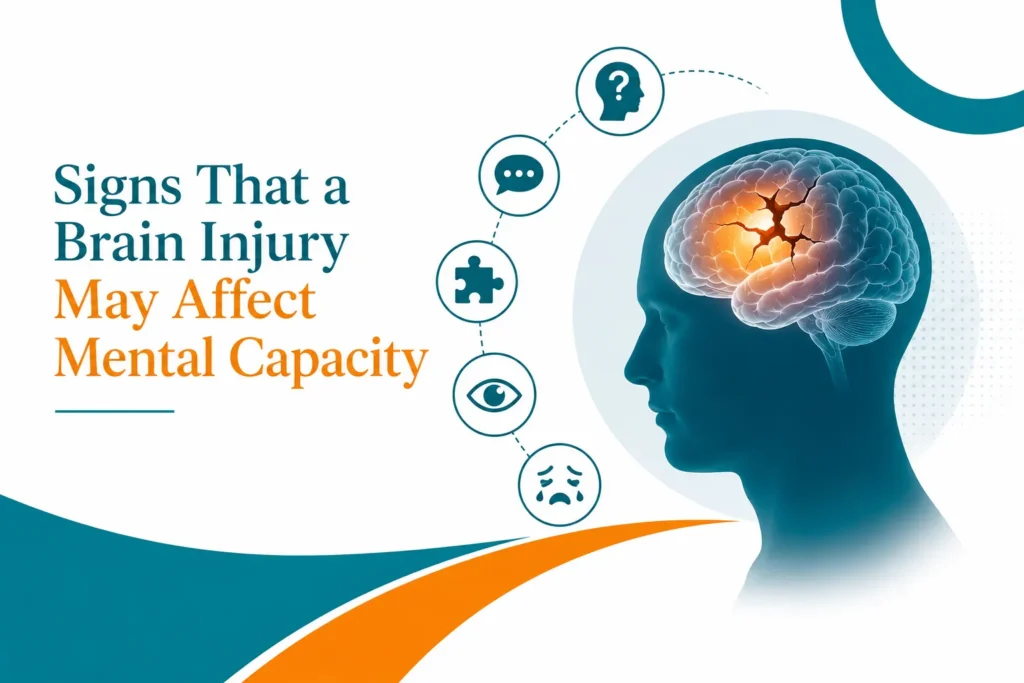
Signs That a Brain Injury May Be Affecting Capacity
The signs below do not confirm that someone lacks capacity. They indicate that an assessment may be needed. A qualified assessor applies the MCA 2005 tests to a specific decision, at a specific time, with all practicable steps taken to support the person. What follows is what to look for before that assessment is instructed.
Memory and Retaining Information
The person forgets what was discussed in the same conversation. They agree to something and then deny it was ever agreed, not because they are being difficult but because the memory of it did not form. Retaining information long enough to make a decision is one of the four functional tests under Section 3. When a brain injury consistently breaks that retention, the retention test may be failing.
Understanding the Decision
The person follows the conversation, nods, and responds appropriately. But when asked what the decision involves or what happens if they choose one option over another, they cannot explain it. The information went in but did not land in a form they can use. This maps to the understand test under Section 3.
Using and Weighing Information
The person can describe a decision clearly and tell you what the options involve. But when the moment of decision arrives, they act on impulse rather than on what they said they understood, or they cannot connect the information to a conclusion. This is the most commonly missed sign in cognitive brain damage cases and the most important one under the MCA 2005. It maps to the use and weigh test.
Mood Changes, Impulsivity, and Behaviour
Irritability, emotional outbursts, and impulsive behaviour that were not present before the injury are not just personality changes. When they interfere consistently with the person’s ability to weigh consequences and regulate decisions, they become capacity concerns. These are among the long-term effects of traumatic brain injury in adults that families observe most but find hardest to name as a legal issue.
Lack of Insight into the Injury
Absence of self-awareness is one of the more unsettling signs in brain injury cases. The person may deny difficulties that are visible to everyone around them. This maps to both the understand and use and weigh tests, and it makes assessment more difficult, not less necessary.
Difficulty Communicating a Decision
The person has something to say but cannot get it out consistently or in a form others can rely on. Communication difficulties after a brain injury can affect spoken language, written expression, or non-verbal communication. The MCA 2005 requires that all practicable steps are taken to support communication before capacity is questioned on this ground.
Post-Traumatic Amnesia and Capacity
After a significant brain injury, there is often a period where the brain cannot form continuous memories. This is called post-traumatic amnesia, or PTA. During this period, the person may seem awake, respond to questions, and hold brief conversations. What they cannot do is carry memories from one moment to the next. They may have no recollection of what was said an hour ago, or even ten minutes ago.
Decisions made during PTA carry a serious legal risk. If someone signs a document, agrees to a financial arrangement, or gives instructions to a solicitor while in PTA, there are real grounds to question whether those decisions had any legal validity. A solicitor who proceeds on instructions taken during this period without raising capacity is exposed.
PTA typically resolves within weeks for moderate injuries. Severe injuries can extend it to months. But resolving PTA does not mean capacity is restored across the board. The brain may recover the ability to form memories while still struggling with the use and weigh function for a specific decision. A separate assessment, tied to the specific decision that needs to be made, is still required under the Mental Capacity Act 2005.
When Someone Appears Capable but May Not Be
Courts in England and Wales have recognised a specific pattern in brain injury cases: a person gives coherent answers, describes what a decision involves, and presents as entirely capable in conversation. Then the actual decision needs to be made, and none of what they said translates into action.
This happens because of damage to executive functioning. Frontal lobe injuries in particular can leave language, memory, and social interaction largely intact while breaking down the mental processes that connect understanding to decision-making. Planning, weighing options, regulating impulse, and following through on a considered conclusion all depend on executive functioning. When that system is damaged, the gap between what someone says and what they do becomes the sign.
It is also the sign most likely to be missed. A brief conversation in a solicitor’s office, or a short assessment using standard cognitive tools, can leave the impression that capacity is present. The impairment doesn’t show up in conversation. It shows up when the person needs to do something with what they said they understood. Specialist legal practitioners in England and Wales have noted this pattern in Court of Protection proceedings specifically, and it is why a brain injury capacity assessment requires a different approach from the tools developed for dementia.
What This Looks Like in Practice
A client comes in for a will appointment. They describe their estate clearly, name the people they want to benefit, and give considered-sounding answers to every question. The following week, their family reports that the client cannot explain what happened at the appointment or what they agreed to.
A person manages a benefits payment independently every month for a year after their injury. Then, over three months, they make a series of financial decisions that contradict everything they said they wanted to do. When asked about it, they describe their original intentions accurately. They cannot account for the gap.
Someone gives instructions to a solicitor at the start of a piece of litigation. At the next appointment, they give completely different instructions. They have no apparent awareness that anything changed.
These are not signs of dishonesty or confusion in the ordinary sense. They are signs that the executive functioning damage is sitting between the conversation and the decision. Referral for a capacity assessment is not a dramatic step at this point. It is the right professional response.
Financial Decisions and the Signs That Matter Most
Property and financial affairs capacity questions make up the majority of brain injury instructions we handle. Impulse control damage from brain injury leaves the ability to discuss money intact. It removes the ability to regulate financial decisions in practice. That gap is where the problem sits.
Here is what that looks like. The person tells you they know they cannot afford something. They describe their budget accurately. Then they make four purchases the same afternoon that contradict everything they just said. Or they agree to hand over a significant sum to someone they met recently, and when asked why, they describe the decision in reasonable-sounding terms that don’t hold up under any scrutiny.
Specific signs worth watching for: repeated purchases without any apparent consideration of the consequences, transferring money or assets to others in ways that were completely out of character before the injury, agreeing to financial arrangements they cannot explain when asked, and a growing susceptibility to persuasion by people around them.
The legal question under the MCA 2005 is not whether the person understands what money is. It is whether they can use and weigh the information relevant to the specific financial decision in front of them. Those are different things, and brain injury can destroy the second while leaving the first completely untouched.
Brain Injury and Dementia: Why the Assessment Differs
Dementia produces a visible, progressive decline that standard cognitive tests pick up reliably. Brain injury doesn’t always work that way. Frontal lobe and executive functioning damage can leave memory, language, and conversational ability largely intact. A person with this kind of injury can score within normal ranges on a standard cognitive screen and still lack capacity for a specific financial or legal decision. The test didn’t catch it because it wasn’t designed for this pattern.
Brain injury capacity cases need neuropsychological evaluation alongside the MCA 2005 functional tests. A standard cognitive screen measures general ability. Functional capacity for a specific decision is a different question, and it needs a different kind of assessment.
When to Ask for an Independent Assessment
You don’t need certainty before requesting an assessment. The Mental Capacity Act 2005 only requires that there is reason to believe capacity may be affected because of an impairment or disturbance in the functioning of the mind or brain. Observable signs, consistently present, satisfy that threshold.
The first situation is a significant decision approaching: financial, legal, or care-related, with the signs consistently present. You raise the question before the decision is made, not after. A significant decision has already been made, and there are grounds to question whether the person had capacity at the time. This is a retrospective assessment. Solicitors encounter this regularly in cases involving wills, property transfers, and financial arrangements made in the period shortly after a brain injury.
The person is involved in legal proceedings and their ability to give consistent instructions or understand what the proceedings involve is in doubt. A solicitor who continues taking instructions in these circumstances without raising capacity carries professional risk. Litigation capacity is a specific assessment, and it applies here.
When an assessment confirms capacity is absent and a decision cannot wait, a Litigation Friend manages decisions about legal proceedings. The Court of Protection appoints a Professional Deputy to manage finances and property. Neither happens automatically. Both need formal steps, and both start with a capacity assessment that establishes what the person can and cannot decide.
How Gain Expert Assessments Approaches Brain Injury Cases
Standard cognitive screens miss executive functioning impairment regularly. A brief test measures general ability. What a brain injury capacity assessment needs to establish is whether the person can use and weigh the information relevant to a specific decision, and that requires a different approach.
We triangulate three things. What the existing documentation and medical history shows. What people who know the person well and see them regularly have observed. And what direct assessment of the person shows when we examine their functional ability for the specific decision in question.
Victoria Sample and the team at Gain Expert Assessments cover England and Wales, including London, the Midlands, Greater Manchester, Yorkshire, the North East, Hampshire and Dorset, and South Wales. Our neuropsychology, social work, and psychiatry professionals work under one roof, which matters when a case involves overlapping concerns. Rated 4.8 out of 5 on Google from 42 reviews. If you are seeing signs that a brain injury may have affected someone’s capacity, call 0330 380 2184 or request an assessment online.
Final thoughts
The hardest cases to catch are the ones where nothing looks obviously wrong. The person holds the conversation, describes what they want, and signs where they are asked to sign. Six months later, a family raises a concern, a solicitor flags an inconsistency, and the question of capacity becomes urgent after the fact.
Getting the assessment right means instructing it before the decision, not after. Victoria and the team at Gain Expert Assessments have handled brain injury capacity cases across England and Wales for years, including the ones where the standard tools gave the wrong picture.
Call 0330 380 2184 or contact Gain Expert Assessments