
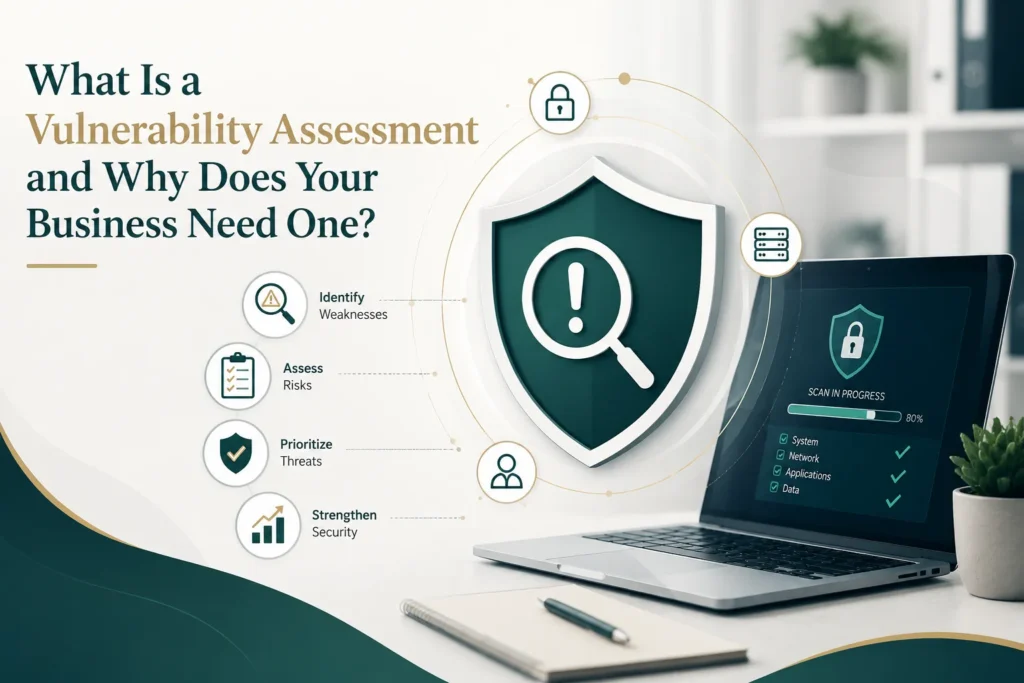
A business can have strong passwords, firewalls, antivirus software and regular backups and still have serious security weaknesses. A server may be running outdated software, a web application may contain a vulnerable component, or an old service may still be exposed to the internet. These problems can remain unnoticed until someone finds and exploits them. A vulnerability assessment helps businesses identify these weaknesses, understand the level of risk and decide what needs to be fixed first.
The National Cyber Security Centre recommends carrying out vulnerability assessments across an organisation’s entire technology estate at least every month. It also recommends more frequent checks for externally reachable services and when serious new vulnerabilities appear. This shows why a vulnerability assessment should not be treated as a one time security exercise. It should form part of an ongoing approach to managing cyber risk.
What Is a Vulnerability Assessment?
A vulnerability assessment is a structured process used to identify security weaknesses in systems, networks, applications and other technology. The assessment can identify outdated software, missing security updates, poor configurations, exposed services and known vulnerabilities. The findings are then reviewed so the business can understand which weaknesses pose the greatest risk.
A vulnerability assessment is more useful when it goes beyond producing a long list of technical findings. A business needs to know which issues matter, why they matter and what should happen next. This is why vulnerability assessment should be viewed as part of vulnerability management rather than simply running a security scanner and saving the resulting report.
How Does a Vulnerability Assessment Work?
A professional vulnerability assessment normally begins by defining what needs to be checked. This may include servers, computers, websites, applications, cloud systems, network devices, databases and internet facing services. The wider and more complicated the technology environment becomes, the more important it is to have an accurate list of assets before testing begins.
Once the scope is clear, security tools can scan the environment for known weaknesses. The results then need to be reviewed and prioritised. Automated tools are useful because they can check large numbers of systems quickly, but they can also produce false positives or miss certain issues. The NCSC recommends considering the accuracy of scanning tools, including how they deal with false positives and false negatives.
What Does a Vulnerability Assessment Check?
The exact checks depend on the business and the agreed scope. A network assessment may examine servers, routers, firewalls, ports and network services. An application assessment may focus on websites, APIs, software and supporting components. A cloud assessment may examine configurations, access controls and exposed resources.
Common areas include:
- Operating systems
- Software versions
- Security updates
- Network services
- Open ports
- Web applications
- Cloud infrastructure
- Remote access services
- Encryption settings
- Access controls
- System configurations
- Known software vulnerabilities
A good assessment should reflect the real environment rather than follow the same checklist for every business. A small company with a handful of systems has different risks from a large organisation with several offices, cloud platforms and hundreds of devices.
What Are the Most Common Vulnerabilities?
Outdated software is one of the most common problems because businesses often use many different systems at the same time. Some applications may be updated regularly while others are forgotten. Unsupported software can create an even greater concern because the supplier may no longer provide security updates.
Configuration problems are also important. A system can have the latest security update and still be exposed because of a poor configuration. Other findings may include unnecessary services, exposed ports, weak access controls, outdated encryption settings and vulnerable software components.
The important thing is not simply to count vulnerabilities. A report with 500 findings may look worse than a report with 50, but the number alone does not tell you the actual business risk. The affected systems, exposure, exploitability and possible impact all need to be considered.
Is Vulnerability Scanning the Same as a Vulnerability Assessment?
No. Vulnerability scanning is normally the automated process of looking for known weaknesses. A vulnerability assessment is broader because it can include scanning, analysis, risk prioritisation and recommendations for remediation.
Think of a scanner as a tool that helps you find possible problems. An assessment helps you understand those problems. The difference becomes important when a business receives a large report and needs to decide what should be fixed immediately and what can be dealt with later.

The NCSC describes regular scanning as an important part of vulnerability management and recommends that organisations maintain a process for identifying and prioritising vulnerabilities.
Vulnerability Assessment vs Penetration Testing
Vulnerability assessments and penetration tests are related but they have different purposes.
|
Vulnerability Assessment |
Penetration Testing |
|
Identifies security weaknesses |
Tests whether weaknesses can be exploited |
|
Often uses automated scanning |
Uses controlled attack techniques |
|
Can cover a broad environment |
Usually has a defined testing scope |
|
Helps prioritise vulnerabilities |
Helps demonstrate possible attack impact |
|
Supports ongoing vulnerability management |
Tests security from an attacker perspective |
A vulnerability assessment can identify a known weakness in a system. A penetration test may attempt to exploit that weakness within an agreed scope to understand what an attacker could potentially achieve. A business may need one service or both depending on its security objectives.
Why Does a Business Need a Vulnerability Assessment?
The biggest reason is simple. You cannot fix a weakness that you do not know exists. Businesses constantly change their technology environments, and every new system, application, update or configuration change can alter their attack surface.
Regular vulnerability assessments can help businesses identify weaknesses before attackers find them. They can also help security teams prioritise their workload, support remediation and provide management with a clearer picture of cyber risk. The NCSC recommends understanding the attack surface and prioritising vulnerabilities based on their potential impact and exposure.
A vulnerability assessment can be particularly useful for businesses that operate public websites, remote access systems, cloud infrastructure or other internet facing services. These systems can be reached from outside the organisation and therefore deserve close attention.
How Should Vulnerabilities Be Prioritised?
Not every vulnerability deserves the same response. A critical weakness on an internet facing server may require immediate action, while a lower risk issue on an isolated system may not have the same urgency.
Technical severity is only one part of the decision. Businesses should also consider whether the affected system is publicly accessible, how important it is to daily operations, whether exploitation is realistic and what could happen if the weakness were exploited. A vulnerability affecting a customer database, for example, may deserve more attention than a similar issue affecting a system with very limited access.
The NCSC recommends regular triage and prioritisation because vulnerability assessments can produce hundreds or even thousands of findings in some environments.
How Often Should a Business Have a Vulnerability Assessment?
The NCSC recommends vulnerability assessments across the entire technology estate at least every month. More frequent assessments may be appropriate for internet facing services or when a serious new vulnerability is discovered.
This approach makes sense because a business environment can change quickly. A new application can introduce a weakness today. A critical software vulnerability can be announced tomorrow. A configuration change can expose a service without anyone realising it. Regular assessment gives the business a better chance of finding those changes before they become security incidents.
Does Every UK Business Need a Vulnerability Assessment?
There is no single rule saying that every UK business must purchase a vulnerability assessment on a specific schedule. The security and compliance requirements that apply to a business depend on its industry, customers, systems, contracts and the type of information it handles.
That does not make vulnerability assessment unnecessary for smaller businesses. A small company can still operate an internet facing website, use cloud services, store customer information and provide remote access to staff. The size of the business should influence the scope of the assessment rather than whether security weaknesses matter.

How Much Does a Vulnerability Assessment Cost in the UK?
There is no standard price because the scope can vary considerably. A small external assessment covering a limited number of systems is very different from an assessment covering an internal network, several applications, cloud infrastructure and multiple locations.
The main factors include the number of assets, type of systems, assessment depth, number of applications, external exposure, reporting requirements and whether manual validation or retesting is included. The NCSC notes that scanning providers commonly base pricing on the number of assets, which is another reason to understand the size of the environment before comparing providers.
A low price is not automatically a good deal. A report filled with findings but lacking useful prioritisation can create more work for an internal team. The better question is what the business receives for the cost and whether the results can actually be used to reduce risk.
What Should a Vulnerability Assessment Report Include?
A useful report should make the technical findings understandable to both security staff and business decision makers. It will normally explain the assessment scope, systems tested, methodology, vulnerabilities discovered, severity, evidence and recommended actions.
A strong report should also help the business decide what to do next. Findings should be prioritised so the security team can work through them in a sensible order. Where possible, remediation advice should explain how the weakness can be addressed and whether further testing should be carried out after the fix.
How Do You Choose a Vulnerability Assessment Service in the UK?
Do not choose a provider based only on price. Before starting, ask what systems will be assessed, whether internet facing assets are included, how false positives are reviewed, how findings are prioritised and what the final report contains.
It is also worth asking whether remediation advice and retesting are available. A good provider should explain the process in plain English and should be clear about what the assessment can and cannot tell you. The scope should be agreed before testing begins so there are no surprises later.
What Should You Do After a Vulnerability Assessment?
The report is not the end of the process. It should give the business a clear list of actions. Critical and high risk issues should normally receive attention first, especially when they affect publicly accessible systems.
Once changes are made, important findings should be checked again. Some weaknesses may require a new scan, while others may need additional testing. The NCSC also recommends having a process for dealing with vulnerabilities that cannot immediately be fixed and making clear decisions about how those risks are managed.
Final Thoughts
A vulnerability assessment is not about producing the biggest possible security report. It is about giving a business a clearer view of its weaknesses and helping the team decide what needs attention.
The most useful assessment is one that leads to action. Find the weakness, understand the risk, fix the problem and check the result. When this process becomes part of normal security management, businesses are in a much stronger position to deal with new threats and changes in their technology environment.