

A solicitor contacts us about a client who was involved in a serious road traffic accident eight months ago. No broken bones. No surgery. But the client has not slept properly since the night it happened, cannot drive, and has stopped going to work. The question is whether a formal psychiatric assessment is needed and, if so, what the report has to say for it to be of any use in the proceedings. That question comes up regularly. The answer depends on what the law actually requires, which legal context you are working in, and who the right expert is for the particular presentation in front of you.
The Legal Standard: What Is a Recognised Psychiatric Illness?
The starting point for any psychiatric injury claim in England and Wales is this: the claimant must have suffered a recognised psychiatric illness. Not distress. Not grief. Not the kind of psychological upset that any reasonable person would feel after a traumatic event.
A positive, diagnosable condition.
Post-Traumatic Stress Disorder, depression, adjustment disorder, and anxiety disorders qualify. The shock of witnessing something terrible, the sadness that follows a bereavement, the anxiety someone feels returning to a place where they were hurt none of these qualify on their own, however genuine they are and however much they have affected the person’s life. This standard was settled in Page v Smith [1996] AC 155, and it remains the governing position.
This is why a letter from a GP is not sufficient on its own. A GP can note that a patient has been presenting with anxiety and disturbed sleep since an accident. That is useful background. What the court needs is a structured diagnostic assessment by a suitably qualified expert who can say, with reference to recognised diagnostic criteria, that this person meets the clinical threshold for a diagnosable psychiatric condition and that the condition was caused by the incident in question.
We see cases where a claimant’s distress is entirely real and clearly significant. They cannot function the way they used to. Their relationships have suffered. Their work has suffered. But when the expert’s report arrives, there is no clear diagnosis and no analysis of causation. Those cases are far harder to run, and the difficulty is usually avoidable.
The condition has to be there. It has to be diagnosable. And someone qualified to make that diagnosis has to say so in a report that meets the legal standard.
If you need to instruct an independent psychiatric expert for a personal injury or clinical negligence matter, call Gain Capacity Experts on 0330 380 2184. We cover England and Wales with home visits and virtual assessments available.
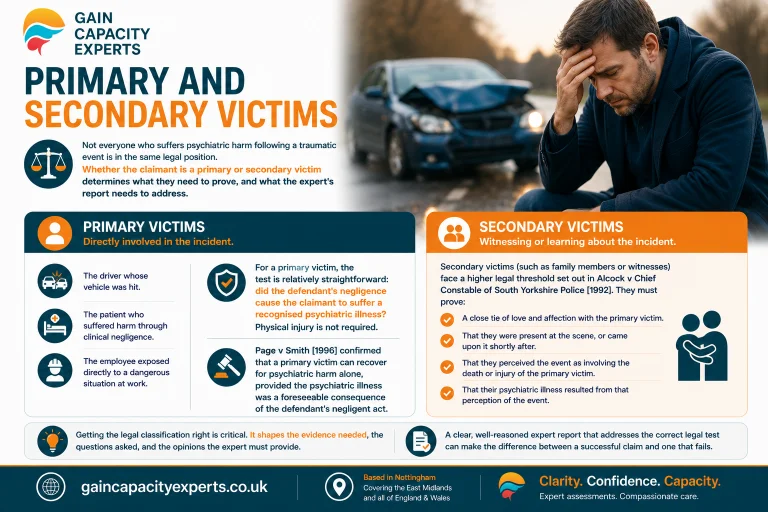
Primary and Secondary Victims
Not everyone who suffers psychiatric harm following a traumatic event is in the same legal position. Whether the claimant is a primary or secondary victim determines what they need to prove, and what the expert’s report needs to address.
Primary victims are those directly involved in the incident. The driver whose vehicle was hit. The patient who suffered harm through clinical negligence. The employee exposed directly to a dangerous situation at work. For a primary victim, the test is relatively straightforward: did the defendant’s negligence cause the claimant to suffer a recognised psychiatric illness? Physical injury is not required. Page v Smith [1996] confirmed that a primary victim can recover for psychiatric harm alone, provided the psychiatric illness was a foreseeable consequence of the defendant’s negligent act.
Secondary victims are those who were not directly involved but witnessed the incident or its aftermath. A parent who arrives at the scene of an accident involving their child. A bystander who witnesses a serious injury. These claimants face a significantly higher evidential threshold, established in Alcock v Chief Constable of South Yorkshire Police [1991] 4 All ER 907 following the Hillsborough disaster. To succeed, a secondary victim must satisfy three requirements: a close tie of love and affection with the primary victim, presence at the scene of the incident or its immediate aftermath, and direct perception of the event rather than learning of it through a third party or through media coverage.
Why does this matter when commissioning an assessment?
Because the report has to address the right questions for the claimant’s position in the case. A report that correctly diagnoses PTSD following a traumatic event but says nothing about the nature of what was witnessed, the claimant’s relationship to the primary victim, or the proximity of their experience to the incident leaves a significant gap in a secondary victim claim. We have seen technically sound clinical reports create real difficulties at trial for exactly this reason. The expert understood the psychiatry. They did not understand what the case legally required of their evidence.
The instructing solicitor needs to make sure the expert knows which category the claimant falls into and what that means for the scope of the assessment.
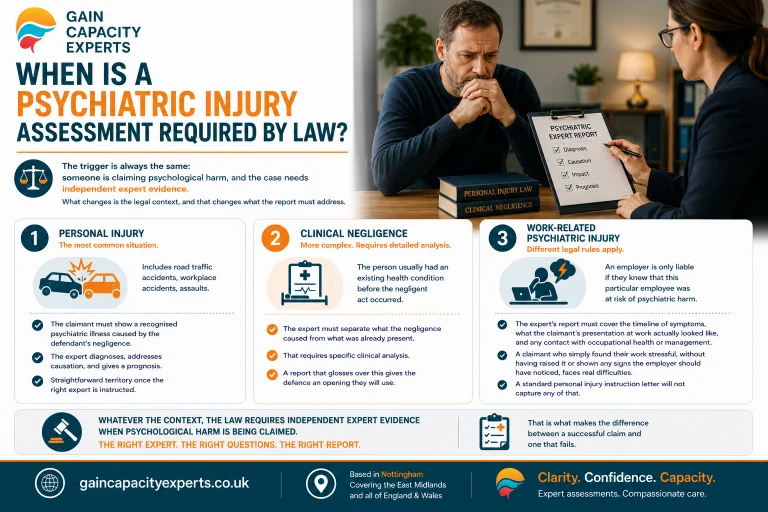
When Is a Psychiatric Injury Assessment Required by Law?
The trigger is always the same: someone is claiming psychological harm, and the case needs independent expert evidence. What changes is the legal context, and that changes what the report must address.
Personal injury is the most common situation. Road traffic accidents, workplace accidents, assaults. The claimant needs to show a recognised psychiatric illness caused by the defendant’s negligence. The expert diagnoses, addresses causation, and gives a prognosis. Straightforward territory once the right expert is instructed.
Clinical negligence is harder. The person usually had an existing health condition before the negligent act occurred. The expert must separate what the negligence caused from what was already present. That requires specific clinical analysis. A report that glosses over this gives the defence an opening they will use.
Work-related psychiatric injury follows different legal rules entirely. An employer is only liable if they knew that this particular employee was at risk of psychiatric harm. A claimant who simply found their work stressful, without having raised it or shown any signs the employer should have noticed, faces real difficulties. The expert’s report must cover the timeline of symptoms, what the claimant’s presentation at work actually looked like, and any contact with occupational health or management. A standard personal injury instruction letter will not capture any of that.
Criminal Injuries Compensation is a separate scheme entirely. The Criminal Injuries Compensation Authority requires a diagnosable psychiatric condition causally linked to a criminal act. The primary victim standard applies.
If you need to instruct an independent psychiatric expert, call Gain Capacity Experts on 0330 380 2184 to discuss the instruction.
Psychiatrist or Psychologist: Which Expert Do You Need?
We get asked this constantly. Here is the plain answer.
A psychiatrist is a medical doctor. They trained in medicine first, worked as a junior doctor, and then specialised in psychiatry. They can diagnose, prescribe medication, and give evidence on conditions with a physical or biological element. They are registered with the General Medical Council.
A clinical psychologist is not a medical doctor. They have a psychology degree and postgraduate clinical training. They are registered with the Health and Care Professions Council. They can assess, diagnose within their scope, and produce medico-legal reports. They cannot prescribe. Both can give expert evidence in court. The question is which one fits the case.
For a straightforward PTSD claim with no significant psychiatric history and no medication involved, a clinical psychologist is often appropriate. For cases with a complex psychiatric history, disputed diagnosis, or significant medication involvement, instruct a psychiatrist. The expert’s qualifications need to match the clinical territory the report covers. A psychologist giving evidence on a presentation that required medical-level psychiatric assessment will face harder questions in cross-examination.
One thing that causes unnecessary problems: the instruction letter needs to be specific. We regularly see letters asking for a “psychological report” when the case clearly needs a psychiatrist. The expert arrives, assesses within their scope, and then a supplementary report is needed. Being clear at the point of instruction saves time and costs. Not sure which discipline is right for your case? Contact our team, and we will advise.
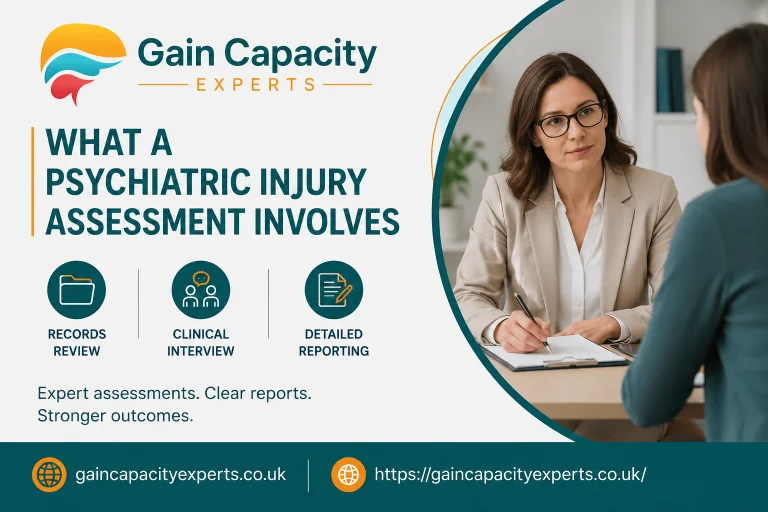
What a Psychiatric Injury Assessment Involves
Most solicitors we speak to have a general sense of what a psychiatric assessment produces. Fewer have a clear picture of what actually happens during one, or what the report must contain for it to hold up in proceedings.
Before the assessment takes place, the expert reviews the relevant records. Medical notes, GP records, occupational health documentation, and any legal papers are provided. This background review matters. An expert who meets the claimant cold, without reading the records first, misses context that shapes the entire assessment.
The clinical interview itself runs between 90 minutes and two hours for most cases. Longer where the presentation is complex or where multiple incidents are involved. The expert takes a full psychiatric history, explores the symptoms in detail, examines the claimant’s current mental state, and probes the relationship between what happened and how the claimant has been affected. This is not a form-filling exercise. It is a structured clinical conversation, and the quality of the report depends heavily on the quality of what happens in that room.
The report must address four things. Diagnosis, using recognised criteria under DSM or ICD. Causation, meaning the link between the negligent act and the psychiatric condition. Prognosis, covering the likely future course of the condition with and without treatment. And it must comply with CPR Part 35, which we cover in the next section.
Causation is where reports most commonly fall short. We see diagnoses that are clinically sound but that do not address whether the incident, rather than a pre-existing vulnerability, actually caused the condition. That gap does not go unnoticed. The opposing party will find it, and they will use it. Our Psychiatric Injury Assessments are carried out by qualified independent psychiatrists and clinical psychologists. Call 0330 380 2184 to discuss an instruction.
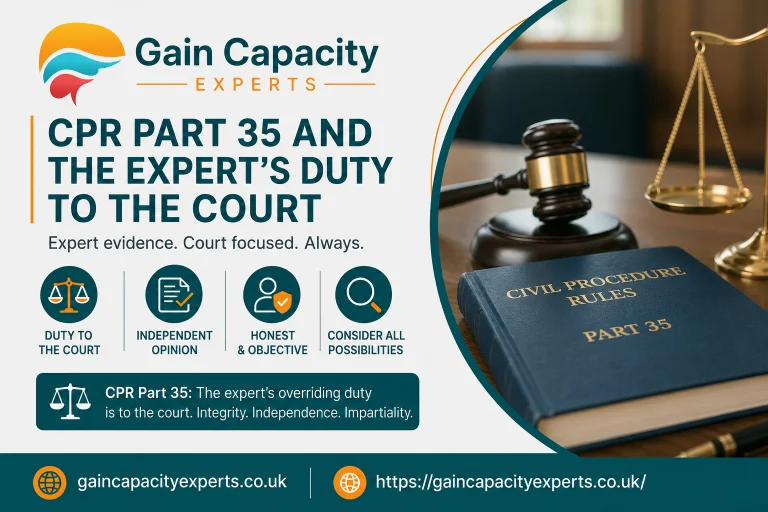
CPR Part 35 and the Expert’s Duty to the Court
CPR Part 35 governs expert evidence in civil proceedings in England and Wales. Every psychiatric injury report used in litigation must comply with it. The most important thing CPR Part 35 establishes is this: the expert’s overriding duty is to the court. Not to the solicitor who instructed them. Not to the claimant. To the court.
This has real consequences. It means the expert must give an honest opinion even where that opinion does not help the instructing party. It means they must acknowledge the limits of their evidence. It means they must consider alternative diagnoses and explain why they have accepted or rejected them.
Under CPR Part 35.3, the report must state the expert’s qualifications, set out what they were asked to address, identify the facts and assumptions their opinion rests on, and include a statement of truth signed by the expert personally.
A report that reads like it was written to support one side will be treated accordingly by the court. We have seen clinically rigorous reports lose significant weight simply because the expert appeared partial. Independence is not just an ethical requirement. It changes what the report is worth in proceedings.
This is also why it matters who you instruct. An expert who understands their duty to the court and writes accordingly produces a report that withstands cross-examination. An expert who does not produces one that creates problems instead of solving them. Our CPR Part 35 Expert Witness Reports are prepared by qualified independent psychiatrists. Call 0330 380 2184.
The Right Report Makes the Difference
Back to that solicitor with the client who has not slept since the accident, cannot drive, and has stopped going to work. The question was whether a formal psychiatric injury assessment is needed and what the report has to say.
The answer is yes, and what the report says is everything. The legal context determines what it must address. The expert’s qualifications determine whether it will hold up. Independence determines whether the court will trust it. A CPR Part 35 compliant report from a suitably qualified psychiatrist or clinical psychologist, addressing diagnosis, causation, and prognosis with genuine clinical rigour, is what the case rests on.
Gain Capacity Experts carries out independent Psychiatric Injury Assessments across England and Wales. One call confirms whether we can help, who the right expert is, and what the instruction involves. Call 0330 380 2184 or contact our team directly.