
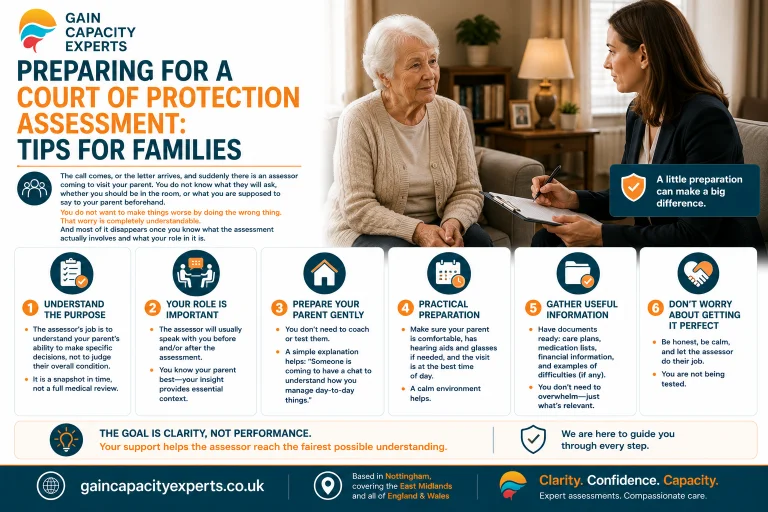
The call comes, or the letter arrives, and suddenly there is an assessor coming to visit your parent. You do not know what they will ask, whether you should be in the room, or what you are supposed to say to your parent beforehand. You do not want to make things worse by doing the wrong thing. That worry is completely understandable. And most of it disappears once you know what the assessment actually involves and what your role in it is.
What the Assessment Involves
The assessor is not testing your family member’s general intelligence or how good their memory is. That surprises a lot of people. They are testing whether the person can make a specific decision. Just one. Maybe it is a decision about managing their bank accounts. Maybe it is a decision about where they live or what care they receive. Whatever the Court of Protection application covers, the assessment is focused on that decision only. Not on the person’s life in general.
To assess that, the assessor looks at four things under the Mental Capacity Act 2005. Can the person understand the relevant information when it is explained to them clearly? Can they hold on to it long enough to think it through? Can they weigh up the options and come to a view? And can they tell the assessor what that view is, in any way that works for them?
That last point matters more than many families realise. Communicating a decision does not have to mean speaking in full sentences. Nodding. Pointing. Using a communication aid. All of it counts.
One more thing worth understanding before the assessment takes place. Capacity is decision-specific and time-specific. The same person can have capacity for one decision and not another. And capacity can change. What the assessor finds on the day of the assessment reflects that particular person at that particular time, in relation to that particular decision. It is not a permanent verdict on who they are or what they are capable of.
If a Court of Protection assessment has been recommended, our team can help. Call Gain Capacity Experts on 0330 380 2184. Home visits and virtual assessments available across England and Wales.
What to Tell Your Family Member Before the Assessment
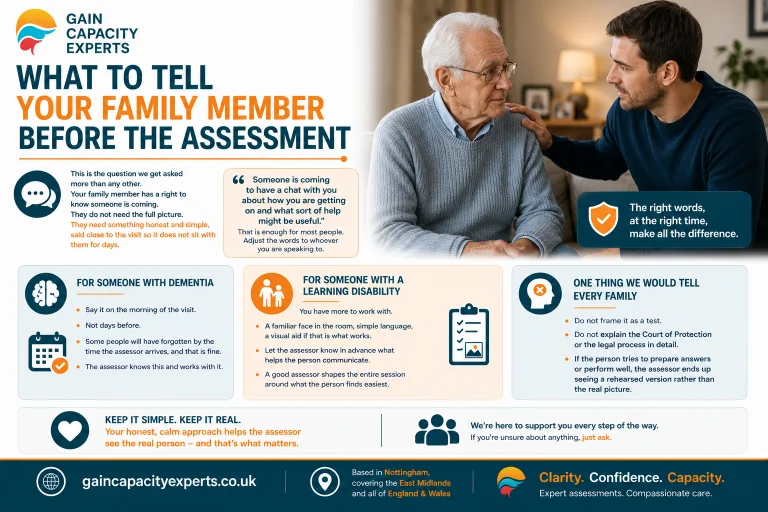
This is the question we get asked more than any other. Your family member has a right to know someone is coming. They do not need the full picture. They need something honest and simple, said close to the visit so it does not sit with them for days. Something like: “Someone is coming to have a chat with you about how you are getting on and what sort of help might be useful.” That is enough for most people. Adjust the words to whoever you are speaking to.
For someone with dementia, say it on the morning of the visit. Not days before. Some people will have forgotten by the time the assessor arrives, and that is fine. The assessor knows this and works with it. For someone with a learning disability, you have more to work with. A familiar face in the room, simple language, a visual aid if that is what works. Let the assessor know in advance what helps the person communicate. A good assessor shapes the entire session around what the person finds easiest.
One thing we would tell every family: do not frame it as a test. Do not explain the Court of Protection or the legal process in detail. If the person tries to prepare answers or perform well, the assessor ends up seeing a rehearsed version rather than the real picture.
The law under the Mental Capacity Act 2005 requires everyone to take all practicable steps to help the person participate in decisions that affect them. That starts before the assessor walks through the door. If you are not sure how to approach this conversation, contact our team before the assessment takes place. A brief call makes the whole process clearer.
Documents to Gather Before the Assessor Arrives
When someone applies to the Court of Protection, they have to submit a form called a COP3. This is the capacity assessment form. Part of it is filled in by your solicitor before the assessment. The other part is completed by the assessor after they have seen your family member. The court cannot process most applications without it.
The assessor needs to know which specific decision the assessment is about before they arrive. Your solicitor’s section of the form explains this. Ask your solicitor to make sure the assessor has seen it before the visit. An assessor who arrives without knowing which decision to focus on spends the first part of the appointment establishing something that should already be clear.
Beyond that, think about what background information will help. If your family member has a care plan or a support plan, share it. It shows the assessor what the person’s day-to-day life actually looks like. If the application involves finances, a recent bank statement gives useful context. If it involves a property, some basic details about that property help.
Medical information is useful but does not have to be exhaustive. A brief letter or summary from the GP or a specialist, if one exists, gives the assessor a clinical picture without you having to pull together years of records.
Communication needs matter just as much as medical history. Write down anything that helps your family member engage: whether they wear a hearing aid, whether they need glasses to read, whether they use any kind of communication aid, whether they have a preferred language. Send this to the assessor before the visit. Do not leave it to the day of the assessment.
We regularly see assessments take longer than they need to because the assessor arrived without a clear picture of the decision they were assessing or the person they were meeting. None of the documents above are difficult to pull together. They just need to be thought about in advance.
Timing and Environment — Getting the Conditions Right
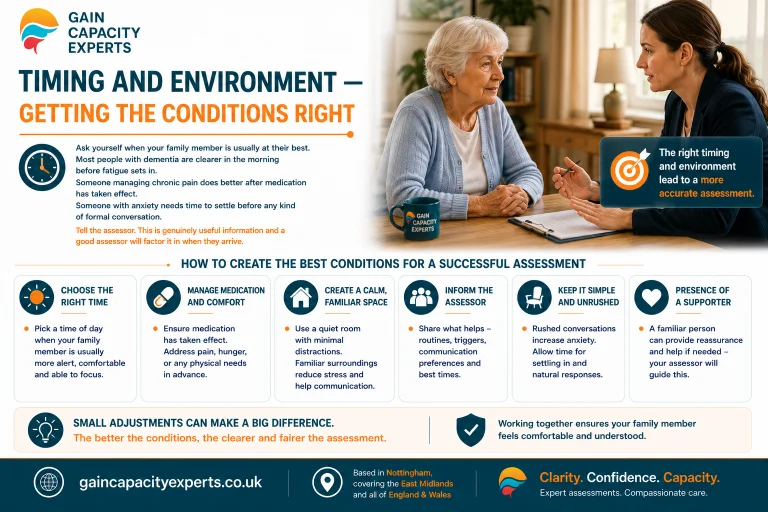
Ask yourself when your family member is usually at their best. Most people with dementia are clearer in the morning before fatigue sets in. Someone managing chronic pain does better after medication has taken effect. Someone with anxiety needs time to settle before any kind of formal conversation. Tell the assessor. This is genuinely useful information and a good assessor will factor it in when they arrive.
The Setting
Home is almost always the right place. Familiar surroundings make a difference that is hard to overstate. The person is less likely to be disoriented, more likely to communicate naturally, and more comfortable with a stranger in the room. Turn the television off. Close unnecessary doors. Hearing aid in. Glasses on. Any communication aids the person uses, have them ready.
If the person usually has a trusted support worker or carer present, it is worth thinking about whether their presence helps or creates performance anxiety. Some people relax with a familiar face there. Others try harder to appear capable than they actually are. You know your family member better than anyone.
What If It Is a Bad Day
This comes up constantly, and families worry about it more than almost anything else.
If the assessment is booked and your family member wakes up significantly more confused than usual, or is clearly unwell, contact the assessor or the instructing solicitor before the visit begins. It is reasonable to flag this. It is not interfering with the process.
Capacity is time-specific under the Mental Capacity Act 2005. An assessment on one bad day does not have to be the only assessment. The assessor is also required to consider whether the person’s presentation might improve and whether a further assessment would be appropriate. One difficult morning is not a verdict.
We have attended assessments where families said nothing about a bad day because they did not want to cause problems, and the assessment produced a result that did not reflect the person at all. Say something. It is the right thing to do.
What to Do — and What Not to Do — on the Day
Meet the assessor at the door. Give them a brief update on how the person is today. Mention anything relevant that has happened recently, whether the person slept well, whether they have been more or less settled than usual. Two minutes of conversation before the assessment starts makes the assessment itself more accurate. Then step back.
Should You Be in the Room
The honest answer is that it depends, and the assessor will discuss it with you. Some people want a family member present because it settles them. Some people respond differently when they know they are being watched by someone they care about. They try harder to answer correctly, or they look to the family member for cues instead of thinking through the question themselves. A good assessor makes this decision based on what gives the best picture of the person, not on what the family prefers. Follow their lead.
What Not to Do
Do not finish sentences. Do not suggest answers. Do not shake your head when the person says something incorrect. Do not nod when they say something right. Do not repeat the assessor’s question back to the person in simpler language unless the assessor asks you to help.
The assessor needs to see what the person can do without support. Every time a family member steps in, the picture changes. We have seen assessments where the family member answered more questions than the person being assessed. They were not trying to undermine the process. They just wanted to help. The effect is the same either way. If the person asks you a question during the assessment, look at the assessor. They will guide you on whether to respond. Our assessors explain what to expect at the start of every visit. If you have questions before the assessment day, call 0330 380 2184.
What Happens After the Assessment
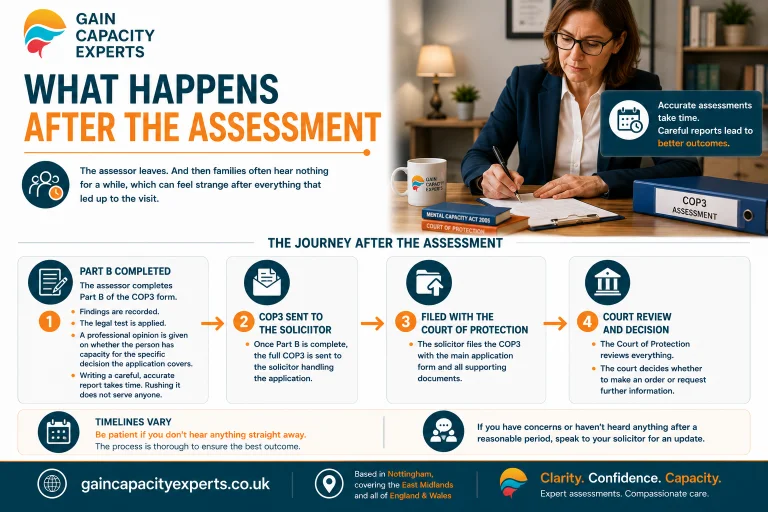
The assessor leaves. And then families often hear nothing for a while, which can feel strange after everything that led up to the visit. After the assessment, the assessor completes Part B of the COP3 form. This is where they record their findings, apply the legal test, and give their professional opinion on whether the person has capacity for the specific decision the application covers. Writing a careful, accurate report takes time. Rushing it does not serve anyone.
Once Part B is complete, the full COP3 goes to the solicitor handling the application. They file it with the Court of Protection along with the main application form. The court then reviews everything and decides whether to make an order or request further information.
How Long Does This Take
A straightforward property and affairs deputyship application typically takes several months from start to order. There is no single fixed timeline because each case moves at its own pace depending on complexity, whether the court has questions, and current caseloads. Sometimes families assume that no news means something has gone wrong. It usually means the court is working through the application in the normal way.
One Practical Point About Timing
The COP3 must reflect the person’s current capacity at the time of assessment. If too much time passes between the assessment and the application being filed, the court may ask for a fresh assessment. This is worth keeping in mind if your solicitor is still gathering other documents after the assessment has taken place. The assessment should not sit unused for months. Once the court makes an order, the appointed deputy registers with the Office of the Public Guardian before taking on any responsibilities. That registration is what formally authorises them to act.
Conclusion
When that call came, or that letter arrived, you did not know what the assessment involved, what to say to your parent, or whether you were going to make things harder by getting something wrong.
You know all of that now. The assessment is not something that happens to your family member without you. What you do in the days before, how you prepare the environment, what you tell the person you are supporting, and how you conduct yourself on the day all of it shapes how the assessment goes. Families who walk in prepared get a better experience. The person being assessed does too.
If you still have questions, or if you need to arrange an independent COP3 assessment for a Court of Protection application, we are ready to help. Contact Gain Capacity Experts or call 0330 380 2184. One conversation tells you exactly what is needed and what happens next.