
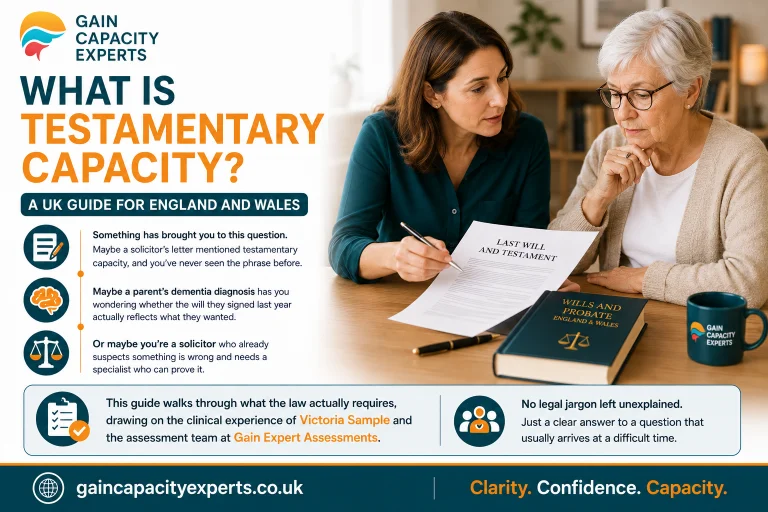
Something has brought you to this question. Maybe a solicitor’s letter mentioned testamentary capacity, and you’ve never seen the phrase before. Maybe a parent’s dementia diagnosis has you wondering whether the will they signed last year actually reflects what they wanted. Or maybe you’re a solicitor who already suspects something is wrong and needs a specialist who can prove it.
This guide walks through what the law actually requires, drawing on the clinical experience of Victoria Sample and the assessment team at Gain Expert Assessments. No legal jargon left unexplained. Just a clear answer to a question that usually arrives at a difficult time.
What Is Testamentary Capacity?
Testamentary capacity is the legal and mental ability to make a valid will. The test for testamentary capacity in England and Wales comes from a 19th-century court case, Banks v Goodfellow, and it still governs every will made today. To meet it, the person must satisfy four specific conditions at the time of signing, covered in full below. Miss one of these and someone can challenge the will.
The Banks v Goodfellow Test: What the Law Actually Requires
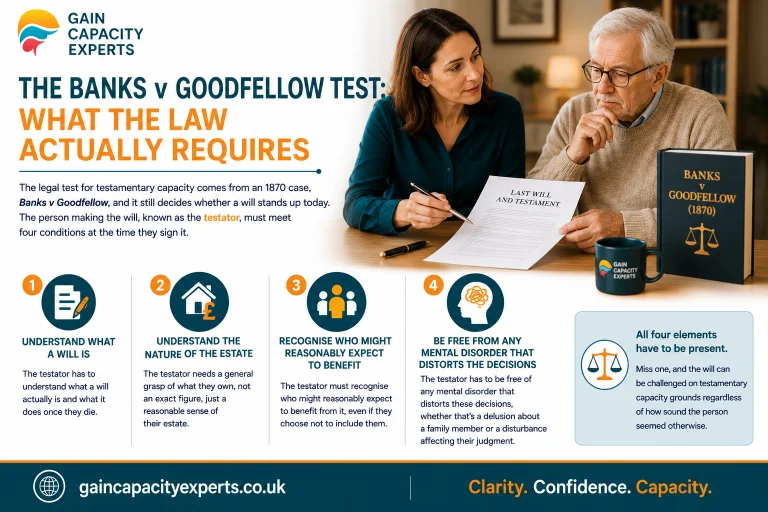
The legal test for testamentary capacity comes from an 1870 case, Banks v Goodfellow, and it still decides whether a will stands up today. The person making the will, known as the testator, must meet four conditions at the time they sign it.
First, the testator has to understand what a will actually is and what it does once they die. Second, they need a general grasp of what they own, not an exact figure, just a reasonable sense of their estate. Third, they must recognise who might reasonably expect to benefit from it, even if they choose not to include them.
The fourth condition trips people up the most. The testator has to be free of any mental disorder that distorts these decisions, whether that’s a delusion about a family member or a disturbance affecting their judgment. All four elements have to be present. Miss one, and the will can be challenged on testamentary capacity grounds regardless of how sound the person seemed otherwise.
Does a Dementia Diagnosis Mean Someone Lacks Capacity?
No. A dementia diagnosis on its own does not mean someone lacked testamentary capacity when they signed their will. What matters is whether they met the Banks v Goodfellow test at that specific moment, not what their medical notes say in general.
This is where a lot of families get it wrong. Someone can have dementia, even a diagnosis that’s progressed quite far, and still have a lucid interval, a period where their thinking clears and they’re able to reason normally again. A person in the early stages of dementia might have a lucid morning, sit down with their solicitor, and make a will that lines up exactly with what they’d always said they wanted. That will can be entirely valid.
The same logic applies to other conditions that raise the question without answering it. Alzheimer’s, a stroke, or delirium can all affect someone’s thinking at different points, but none of them automatically invalidate a will on their own; they only mean the timing of the assessment matters more than the diagnosis itself.
What Is the Golden Rule in Will-Making?
The Golden Rule is a practical safeguard, not a piece of legislation. It says that when a solicitor takes instructions for a will from someone older, seriously ill, or otherwise at risk of a capacity challenge, they should arrange a contemporaneous capacity assessment before the testator signs the will, not scramble to prove capacity after a dispute has already started.
Getting an assessment now, while you can sit down and be evaluated directly, gives your will a strength that no amount of after-the-fact argument can match. If you’re a solicitor working with a client whose health or age could invite a challenge later, this is the moment to act, not after the funeral, when the only option left is reconstructing what someone’s mental state was months or years earlier.
The same logic applies if you’re planning your own will and have a health condition that might raise questions down the line. Gain’s assessors carry out exactly this kind of preventative assessment, working alongside solicitors who want a will to hold up rather than get picked apart.
Why Independence Matters When Assessing Testamentary Capacity
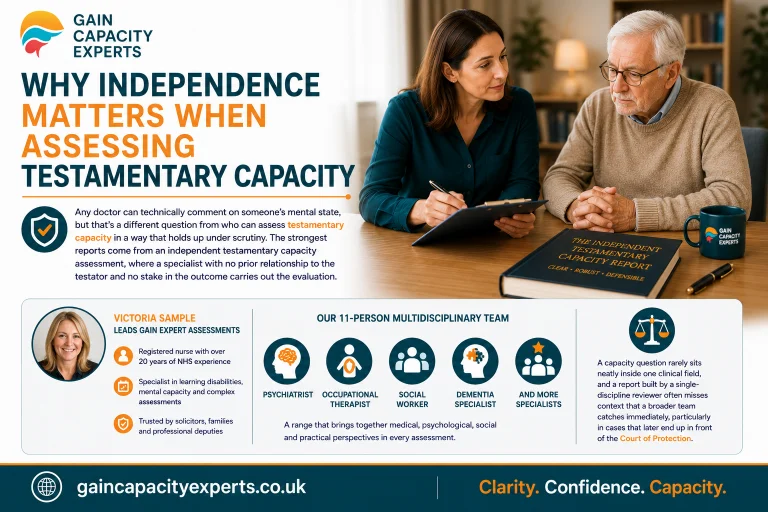
Any doctor can technically comment on someone’s mental state, but that’s a different question from who can assess testamentary capacity in a way that holds up under scrutiny. The strongest reports come from an independent testamentary capacity assessment, where a specialist with no prior relationship to the testator and no stake in the outcome carries out the evaluation.
Victoria Sample leads Gain Expert Assessments, a registered nurse with over 20 years of NHS experience in learning disabilities, working alongside an 11-person multidisciplinary team that includes a psychiatrist, an occupational therapist, a social worker, and a dementia specialist. That range matters. A capacity question rarely sits neatly inside one clinical field, and a report built by a single-discipline reviewer often misses context that a broader team catches immediately, particularly in cases that later end up in front of the Court of Protection.
| Feature | GP or Medical Records | Independent Specialist Assessment |
|---|---|---|
| What It Shows | General health history, not built around the legal test | Direct evaluation against the Banks v Goodfellow test |
| Who Conducts It | Existing treating clinician, may know the family | Independent assessor with no prior relationship |
| Weight in Contentious Probate | Often incomplete or open to challenge | Built specifically to withstand scrutiny |
A GP’s notes might mention confusion or memory issues in passing, but the GP didn’t write them with testamentary capacity in mind, and that gap becomes obvious the moment someone challenges the case. An independent report is built from the ground up to answer the legal question directly, which is exactly why courts and solicitors give it more weight.
If you’re weighing up whether an independent report would strengthen your position, Gain’s assessors can talk you through what’s involved before you commit to anything. Call 0330 380 2184 to ask a question, no obligation.
What Is a Retrospective Testamentary Capacity Assessment?
A retrospective testamentary capacity assessment looks backward. Instead of evaluating someone’s capacity right now, the assessor reviews medical records, witness accounts, and the circumstances around the day the will was signed to form a view on whether the testator had capacity back then.
This is the assessment solicitors reach for once a will has already been contested, and it’s just as relevant for families who only start questioning a will after someone has died. By that point, the testator can’t be assessed directly, so the entire report rests on reconstructing their mental state from whatever evidence exists. Gain carries out this type of retrospective assessment directly, working from GP records, care notes, solicitor files, and witness statements to build a clinically grounded picture of capacity at the relevant date.
The difference between this and the Golden Rule assessment covered earlier comes down to timing, not method. A contemporaneous assessment happens while the testator is alive and able to be evaluated directly, which is always the stronger position if it’s available. A retrospective assessment is what’s left once that window has closed, and it depends entirely on the quality of the records still on file.
If the will in question has already been signed and you’re questioning whether it should stand, a retrospective assessment may give you the clarity you need. Gain’s team can advise on whether your case is suitable. Get in touch on 0330 380 2184.
The Evidence That Matters in a Capacity Dispute
If you’re trying to work out how to prove lack of testamentary capacity, the answer usually comes down to three things: medical records from around the time the will was signed, the solicitor’s attendance notes from the signing itself, and witness testimony from anyone who saw the testator that day.
Attendance notes carry more weight than most people expect. A solicitor who asks the right questions and writes down exactly what the testator said and how they responded can end up being the single strongest piece of evidence in a dispute, sometimes stronger than the medical records themselves. Witness testimony fills in the gaps around that, describing how the testator seemed, what they said, whether anything felt off.
None of these on their own settle the question, though. Medical records show general health, attendance notes show one conversation, and witnesses remember things imperfectly months or years later. Whoever is arguing the case still carries the burden of proof, and that’s exactly where an independent assessment earns its place, weighing all of that evidence together against the legal test rather than leaving a court to piece it together itself.
Testamentary Capacity Assessments in Nottingham and Across England and Wales
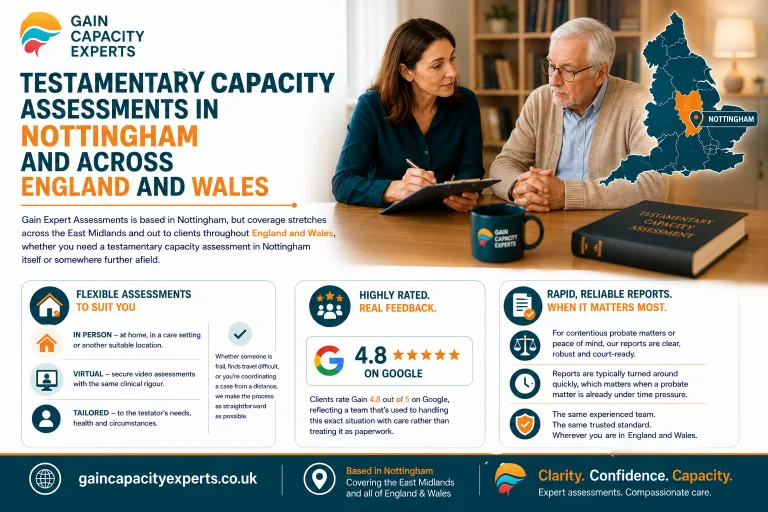
Gain Expert Assessments is based in Nottingham, but coverage stretches across the East Midlands and out to clients throughout England and Wales, whether you need a testamentary capacity assessment in Nottingham itself or somewhere further afield.
Assessments happen either in person, at home, or virtually, whichever suits the testator’s circumstances better. Someone who’s frail or finds travel difficult can be seen at home, while a solicitor coordinating a case from a distance can arrange a virtual assessment without losing any of the clinical rigour behind it. That flexibility matters more than it sounds, because delays in arranging an assessment can sometimes matter as much as the assessment itself.
Clients rate Gain 4.8 out of 5 on Google, which reflects a team that’s used to handling this exact situation with care rather than treating it as paperwork. Whether you need a testamentary capacity assessment across England and Wales for a contentious probate matter or a single home visit in Nottingham, the same team and the same standard apply. Reports are typically turned around quickly, which matters when a probate matter is already under time pressure.
Get an Independent Testamentary Capacity Assessment
Whether you’re a family member trying to understand what happened after a death, or a solicitor building a case around a contested will, one question usually sits underneath everything else. Did this person understand what they were signing?
Gain Expert Assessments carries out independent, court-ready assessments across England and Wales, with home visits and virtual options available depending on what suits your situation. Call 0330 380 2184 to talk it through. No pressure. No commitment