
Somewhere between a hospital corridor and a solicitor’s waiting room, most families first hear the phrase “COP3 form”. Usually it’s a nurse or a social worker who says it, almost in passing, right after they’ve explained that Mum can no longer manage her own bank account. Nobody warns you it’s coming. One week you’re just worried about your parent. Next, you’re being asked to gather medical evidence for the Court of Protection, and the whole thing feels like it’s written in a language you weren’t given the dictionary for.
That confusion is normal. A COP3 capacity assessment sits right at the centre of that confusion, because it’s the piece of medical evidence that tells the court whether someone can still make a specific decision for themselves. Get it wrong, or leave it too late, and the whole application can stall for months. Understand it early, and the rest of the process becomes a lot more manageable.
This guide walks through exactly what a COP3 is, who needs one, who’s allowed to complete it, what actually happens in the room, and what it costs. We’ll flag the mistakes we see families make repeatedly, because most of them are avoidable once you know what to look for.
Quick Summary
A COP3 is the Court of Protection’s official capacity assessment form. Part A is completed by the person applying (often a family member or their solicitor), and Part B is completed by a qualified assessor, typically a GP, psychiatrist, psychologist, or independent capacity specialist. It’s filed alongside form COP1 whenever someone applies to the court for authority over another person’s decisions, most often for deputyship over property and finances, or over health and welfare.
The assessment itself usually takes 45 minutes to an hour and a half, depending on the complexity of the decision being assessed. Costs vary widely: a GP might charge a modest fee or decline altogether, while an independent specialist assessment typically runs into several hundred pounds, reflecting the time needed to produce a court-ready report. Once the form is completed, it goes to the court with the rest of the application, and the court uses it, alongside everything else submitted, to decide whether an order is needed.
None of that is complicated in theory. What trips people up is the detail, so let’s get into it properly.
What Is a COP3 Capacity Assessment?
A COP3 capacity assessment is a formal evaluation of whether someone has the mental capacity to make a specific decision, recorded on the Court of Protection’s official COP3 form. It’s required for most applications to the court and must be current at the time you file.
What Does the COP3 Form Actually Do?
The form has two parts. Part A is filled in by whoever is applying to the court, and it sets out exactly which decision or decisions the court is being asked to make. Part B is filled in by the assessor, and this is where the real substance sits. The assessor has to record their professional relationship to the person, confirm they’re giving an independent opinion, and set out the relevant information the person would need to understand, retain, use, and weigh in order to make that decision.
That last part matters more than most people realise. Capacity isn’t a general label. It’s tied to one specific decision at one specific point in time.
Why the Court of Protection Requires It
The court can’t make sweeping judgements about someone’s mind from a distance. It relies on medical evidence, and COP3 is the standard vehicle for that evidence. Practice Direction 9A is fairly blunt about it: a COP3 must be filed with the application in almost every case, with only a narrow set of exceptions, such as certain Lasting Power of Attorney matters. If it genuinely isn’t possible to get one in time, the applicant has to explain why, and even then, the court expects proper evidence to follow quickly.
How It Supports Legal Decision-Making
Without COP3, the court is working blind. With it, a judge can see clearly whether someone genuinely lacks capacity for the decision in question, what support was tried first, and what the practical consequences are. That evidence base is what allows the court to act in the person’s best interests rather than guessing.

When Is a COP3 Capacity Assessment Needed?
You’ll need a COP3 whenever you’re applying to the Court of Protection for authority to make a decision on someone else’s behalf, and there’s no valid Lasting Power of Attorney already in place covering that decision.
Applying for Deputyship
This is the most common trigger. If a family member can no longer manage their finances or make welfare decisions, and they never set up an LPA while they had capacity, someone has to apply to become their deputy. COP3 goes in with that application.
Property and Financial Affairs
Selling a house to fund care, managing pensions, or handling an inheritance on someone’s behalf all fall under this category. The assessor needs to address the specific financial decision at hand, not just capacity in general.
Health and Welfare Decisions
Where a decision touches on where someone lives, their care arrangements, or medical treatment, a separate strand of assessment applies, often alongside broader best-interests processes.
Other Legal Situations Requiring Evidence
Statutory wills, gifting applications above what an attorney or deputy would normally be permitted to authorise, and removing a trustee can all require a COP3 as supporting evidence.
Who Needs a COP3 Capacity Assessment?
Anyone whose ability to make a specific decision is in genuine doubt because of an impairment or disturbance affecting how their mind or brain works may need one.
Older Adults With Dementia
This is the scenario most families picture, and often it starts small. A missed bill here, a confused phone call there. By the time a COP3 is being discussed, the family has usually already noticed the pattern for months.
People With Acquired Brain Injuries
Capacity after a brain injury can be genuinely unpredictable. Someone might reason clearly about day-to-day matters yet struggle badly with anything involving long-term financial consequences. That’s exactly why decision-specific assessment matters here.
Individuals With Learning Disabilities
Some adults with learning disabilities have always needed support with certain decisions, and a deputyship is set up early rather than in response to sudden change.
People Experiencing Serious Mental Illness
Conditions like severe psychosis or advanced bipolar disorder can, during acute episodes, genuinely affect someone’s ability to weigh information, even though their capacity may return once the episode passes.
Temporary Loss of Capacity
Delirium, a severe infection, or the aftermath of major surgery can all cause short-term capacity loss. In these cases, timing the assessment correctly, and sometimes waiting a little, matters as much as the assessment itself.
Who Can Complete a COP3 Assessment?
Part B of the form must be completed by an appropriately qualified professional, and the form itself gives examples rather than a rigid closed list.
GPs
A GP who knows the person well can sometimes complete it, and their existing relationship with the patient can be genuinely valuable. The trade-off is availability. Many GP practices are stretched thin, and completing a court-ready capacity report takes real time that a ten-minute appointment slot simply doesn’t allow for.
Psychiatrists
For complex mental health presentations, a consultant psychiatrist’s opinion carries real weight with the court, particularly where the underlying condition is psychiatric rather than purely cognitive.
Neurologists
Where the capacity question is closely tied to a specific neurological condition, such as early-onset dementia or the aftermath of a stroke, a neurologist’s assessment can be more directly relevant than a generalist’s.
Independent Medical Specialists
Independent assessors who specialise specifically in Mental Capacity Act work tend to be the most efficient route for families, largely because assessing capacity properly and writing it up in a way the court expects is a specific skill, separate from general clinical practice.

Why Independent Assessments Are Sometimes Preferred
Speed is the honest answer, most of the time. NHS waiting lists for a formal capacity assessment can run long, and an application can’t move forward without one. An independent assessor who does this work routinely can usually offer an appointment far sooner, and because they write these reports constantly, the finished document tends to need fewer follow-up queries from the court.
Many families start by asking their GP, which is often the right first step. If appointments are unavailable or court deadlines are approaching, it may help to understand how independent assessments work and when they are appropriate. Our guide to independent COP3 capacity assessments explains what to expect, who carries them out, and how the process compares with other options.
What Happens During a COP3 Capacity Assessment?
The assessor meets the person, explains what’s happening in plain language, and works through the specific decision in question using the legal test set out in the Mental Capacity Act.
Preparing for the Appointment
It helps enormously if the family gathers relevant medical history, any existing diagnoses, and a clear written note of the specific decision the application concerns before the appointment happens.
Questions You May Be Asked
Expect open, conversational questions rather than a rigid test. The assessor is trying to understand how the person processes information, not catch them out.
How Mental Capacity Is Evaluated
The assessment follows the legal framework in the Mental Capacity Act 2005, which looks at four specific abilities in relation to the decision at hand.
Understanding Information
Can the person understand the information relevant to the decision once it’s explained in a way that suits them?
Retaining Information
Can they hold onto that information long enough to actually use it, even if only briefly?
Weighing Information
Can they use it as part of the process of making the decision, balancing the different factors involved?
Communicating a Decision
Can they communicate their decision by any means, whether that’s speech, writing, or another form of communication?
If someone can’t do even one of those four things in relation to that specific decision, and it’s because of an impairment or disturbance in the functioning of the mind or brain, they’re treated as lacking capacity for that decision.
Preparing properly before the appointment can make the assessment feel much less stressful. Families who know what documents to gather and what the assessor is looking for often find the process more straightforward. At Gain Capacity Experts, we’ve put together practical guidance covering appointments, preparation, and common questions if you’d like to read more.
How Long Does a COP3 Capacity Assessment Take?
COP3 Assessment Timeline
| Step | What Happens | Typical Timeframe |
|---|---|---|
| Referral | Initial enquiry and scoping of the decision | Same day to a few days |
| Booking | Appointment arranged with an assessor | A few days to several weeks |
| Assessment | The capacity evaluation itself | 45 minutes to 90 minutes |
| Report | COP3 Part B written and finalised | 3 to 10 working days |
| Court | Application submitted with COP1 | Ongoing court processing |
Typical Appointment Length
Most assessments last somewhere between 45 minutes and an hour and a half. Complex cases involving multiple decisions understandably take longer.
Report Completion Times
Once the appointment is done, turning it into a finished, court-ready report usually takes anywhere from a few days to around two weeks, depending on the assessor’s workload and how much detail the case requires.
Court Submission Timelines
The COP3 itself is only one part of the wider application. Once it’s filed with COP1, the court’s own processing time runs separately, and that can vary considerably by region and caseload.
How Much Does a COP3 Capacity Assessment Cost?
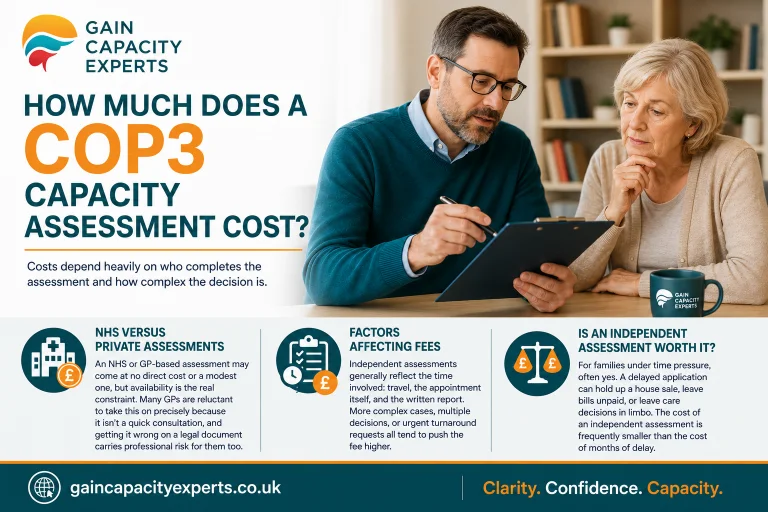
Costs depend heavily on who completes the assessment and how complex the decision is.
NHS Versus Private Assessments
An NHS or GP-based assessment may come at no direct cost or a modest one, but availability is the real constraint. Many GPs are reluctant to take this on precisely because it isn’t a quick consultation, and getting it wrong on a legal document carries professional risk for them too.
Factors Affecting Fees
Independent assessments generally reflect the time involved: travel, the appointment itself, and the written report. More complex cases, multiple decisions, or urgent turnaround requests all tend to push the fee higher.
Is an Independent Assessment Worth It?
For families under time pressure, often yes. A delayed application can hold up a house sale, leave bills unpaid, or leave care decisions in limbo. The cost of an independent assessment is frequently smaller than the cost of months of delay.
GP vs Independent Assessor
| Feature | GP | Independent Specialist |
|---|---|---|
| Waiting Time | Often several weeks | Often days |
| Familiarity with COP3 Reports | Variable | Consistently high |
| Availability for Complex Cases | Limited | Strong |
| Typical Cost | Low or none | Moderate, reflecting time and expertise |
Can Someone Fail a COP3 Capacity Assessment?
Capacity isn’t pass or fail in the way people assume, and that’s one of the most misunderstood parts of the whole process.
Understanding What Capacity Really Means
Someone isn’t “found incapable” in a general sense. They’re assessed against one specific decision. A person can lack capacity to manage a complex investment portfolio while retaining full capacity to decide what they’d like for lunch.
Decision-Specific Capacity Explained
This is the principle that trips up the most families. We regularly see relatives assume that once a COP3 confirms a lack of capacity for finances, the same applies automatically to health decisions. It doesn’t. Each decision type needs its own consideration.
Common Misconceptions
The biggest one is assuming capacity is fixed. It isn’t. Someone can lack capacity for a decision today and regain it later, particularly where the cause is temporary, like an infection or medication side effect.
What Happens After the COP3 Assessment?
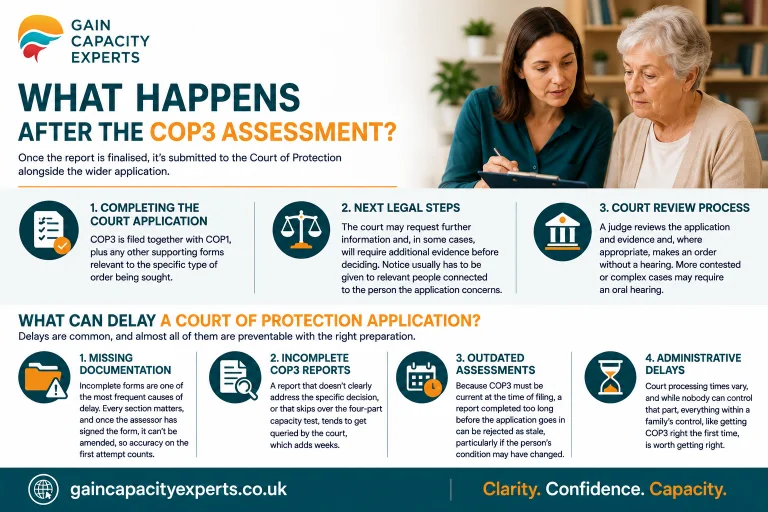
Once the report is finalised, it’s submitted to the Court of Protection alongside the wider application.
Completing the Court Application
COP3 is filed together with COP1, plus any other supporting forms relevant to the specific type of order being sought.
Next Legal Steps
The court may request further information and, in some cases, will require additional evidence before deciding. Notice usually has to be given to relevant people connected to the person the application concerns.
Court Review Process
A judge reviews the application and evidence and, where appropriate, makes an order without a hearing. More contested or complex cases may require an oral hearing.
What Can Delay a Court of Protection Application?
Delays are common, and almost all of them are preventable with the right preparation.
Missing Documentation
Incomplete forms are one of the most frequent causes of delay. Every section matters, and once the assessor has signed the form, it can’t be amended, so accuracy on the first attempt counts.
Incomplete COP3 Reports
A report that doesn’t clearly address the specific decision, or that skips over the four-part capacity test, tends to get queried by the court, which adds weeks.
Outdated Assessments
Because COP3 must be current at the time of filing, a report completed too long before the application goes in can be rejected as stale, particularly if the person’s condition may have changed.
Administrative Delays
Court processing times vary, and while nobody can control that part, everything within a family’s control, like getting COP3 right the first time, is worth getting right.
What Are the Most Common Questions Families Ask?
Can Someone Refuse the Assessment?
They can decline to take parAsk.nd the assessor should record that clearly. The court will then need to consider whatever alternative evidence is available.
Can Capacity Change Over Time?
Yes, in both directions. Conditions like dementia tend to progress, while temporary causes like delirium often resolve, sometimes fully.
Can Another Assessment Be Requested?
Yes. If circumstances change or if there’s a genuine dispute about the findings, a fresh or second-opinion assessment can be arranged.
How Can Families Prepare for a COP3 Assessment?
A little preparation makes a genuine difference to how smoothly the appointment goes.
Documents to Gather
Relevant diagnoses, existing care plans, and any prior capacity assessments should be ready before the appointment starts.
Medical Records
A short summary of the person’s relevant medical history, provided by the family or GP, helps the assessor understand the wider picture quickly.
Questions to Prepare
Write down the exact decision the application concerns. Vague framing at this stage often causes back-and-forth later.
Practical Tips for the Appointment
Choose a time of day when the person is typically at their most alert, keep the environment calm and familiar where possible, and make sure any communication aids they normally use are on hand.
What Common Myths About COP3 Assessments Should You Ignore?
Myth: Only Elderly People Need One
Brain injuries, learning disabilities, and mental illness affect people of every age, and COP3 applies just as much to a 28-year-old as to an 88-year-old.
Myth: Capacity Is Permanent
As covered above, this simply isn’t true. Capacity is assessed at a point in time for a specific decision.
Myth: Every GP Completes COP3 Forms
Many are willing in principle but constrained by time, and some decline altogether given the detail required.
Myth: The Assessment Decides Deputyship
COP3 provides evidence. The court makes the actual decision, weighing the assessment alongside everything else submitted.

How Do Independent COP3 Assessors Support the Process?
Faster Appointments
Because assessing capacity is their core work rather than one item on a long clinical list, independent assessors typically offer far quicker appointment availability.
Specialist Experience
Repeated, focused experience with the Mental Capacity Act tends to produce reports that hold up well under court scrutiny.
Court-Ready Reports
Reports written specifically with COP3’s requirements in mind tend to generate fewer follow-up queries from the court, which keeps the wider application moving.
National Assessment Availability
For families dealing with relatives in different parts of the country or arranging remote assessments where appropriate, independent providers can often offer more flexible coverage than a single local GP practice.
At Gain Capacity Experts, this is the specific gap we built our service around. Families come to us after weeks stuck waiting for an NHS slot, often with a court deadline creeping closer. We’re not trying to replace the role a GP plays in someone’s ongoing care. We’re there for the specific, time-pressured job of producing a clear, properly evidenced COP3 report that the court can act on without sending it back for clarification.
Final Thoughts
A COP3 capacity assessment isn’t just paperwork. It’s the piece of medical evidence that lets the Court of Protection act with confidence in someone’s best interests, and getting it right the first time saves families weeks, sometimes months, of unnecessary delay. If you’re facing this now, the most useful thing you can do is get clear on the exact decision the application concerns, gather the relevant medical background early, and book the assessment with someone who understands what the court actually needs to see. Where a GP route isn’t fast enough, an independent assessor can often close that gap considerably. Whichever route you take, understanding the process now puts you well ahead of where most families start.
If you’d like help arranging a COP3 assessment, our team at Gain Capacity Experts works with families and solicitors across the country to keep this part of the process as calm and timely as possible.