
What Is Mental Capacity?
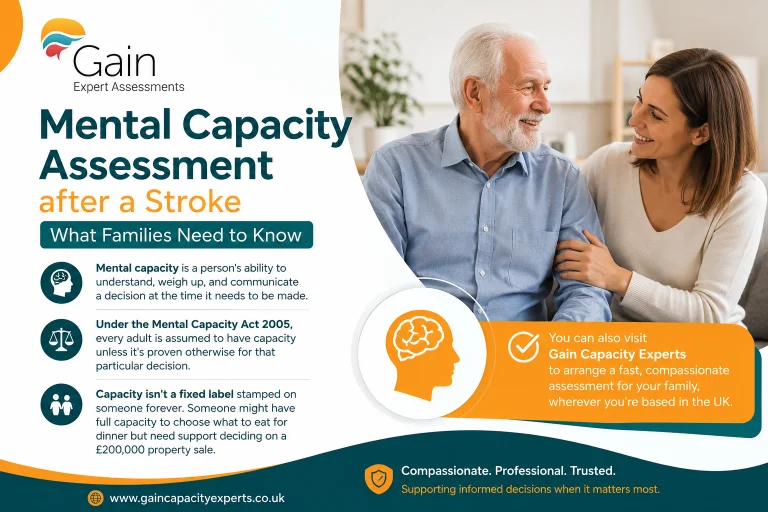
Mental capacity is a person’s ability to understand, weigh up, and communicate a decision at the time it needs to be made. Under the Mental Capacity Act 2005, every adult is assumed to have capacity unless it’s proven otherwise for that particular decision. Capacity isn’t a fixed label stamped on someone forever. Someone might have full capacity to choose what to eat for dinner but need support deciding on a £200,000 property sale. That’s the part people often miss, and it trips up even experienced professionals.
You can also visit Gain Capacity Experts to arrange a fast, compassionate assessment for your family, wherever you’re based in the UK.
The Presumption of Capacity
The Act starts from a position of respect, not suspicion. You don’t get to assume incapacity because someone is older, had a stroke, or speaks slowly now. The burden is on showing they lack capacity, not the other way around.
Can a Stroke Affect Mental Capacity?
Yes, sometimes. A stroke can damage parts of the brain responsible for memory, reasoning, attention, or language, and those changes can genuinely affect someone’s ability to understand or weigh information. But “can affect” is not “always affects.” I’ve reviewed cases where a stroke left someone with significant speech difficulty and full decision-making ability underneath it and cases where the opposite was true, fluent speech masking a real gap in understanding.
Temporary vs Permanent Effects
Right after a stroke, confusion, fatigue, and medication can all cloud thinking temporarily. That’s why timing matters so much in an assessment. A capacity assessment done three days post-stroke, during the acute phase, can look completely different from one done three months later once swelling has reduced and rehabilitation has progressed.
Communication Difficulties Are Not the Same as Lack of Capacity
This is probably the single biggest misunderstanding I see. Aphasia, the loss or impairment of language ability after stroke, affects how someone expresses a decision. It does not necessarily affect whether they understand it. Someone with severe aphasia may know exactly what they want and simply struggle to say it without support.
Does Every Stroke Survivor Lose Mental Capacity?
No. Most don’t. Every stroke is different depending on which part of the brain was affected, how quickly treatment started, and the person’s overall health beforehand. Capacity can also fluctuate during the first weeks of recovery, improving as swelling goes down and rehabilitation kicks in. Assuming someone “isn’t all there” because of a stroke is one of the fastest ways families and even professionals get this wrong, and it’s exactly the kind of unwise shortcut the law was written to prevent.
Mental Capacity vs Cognitive Impairment
These two get confused constantly, and the difference matters. “Cognitive impairment” describes a change in brain function, things like slower processing, memory gaps, and reduced concentration. Mental capacity is a legal and functional test of whether someone can use that brain function to make a specific decision right now. Someone can have noticeable cognitive impairment and still have full capacity for most decisions. The two aren’t the same thing, and treating them as interchangeable is a mistake I’ve seen cost families real legal trouble.
Common Signs Someone May Need an Assessment
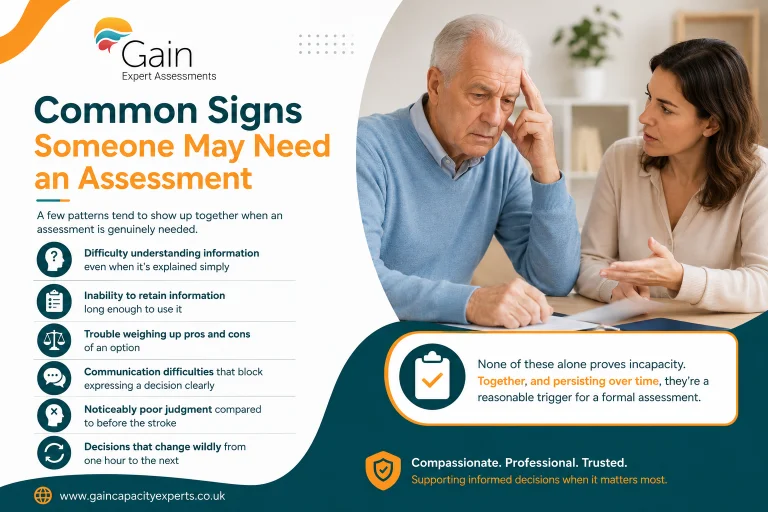
A few patterns tend to show up together when an assessment is genuinely needed.
- Difficulty understanding information even when it’s explained simply
- Inability to retain information long enough to use it
- Trouble weighing up pros and cons of an option
- Communication difficulties that block expressing a decision clearly
- Noticeably poor judgment compared to before the stroke
- Decisions that change wildly from one hour to the next
None of these alone proves incapacity. Together, and persisting over time, they’re a reasonable trigger for a formal assessment.
When Is a Mental Capacity Assessment Needed?
Capacity assessments come up far more often than people expect. The most common triggers include medical treatment decisions, hospital discharge planning, financial decisions, property and housing choices, setting up a lasting power of attorney, will-making, care home placement, and Court of Protection proceedings. If you’re a family considering any of these and something feels off about how your relative is processing it, that’s the moment to ask for an assessment rather than guess.
How Is Mental Capacity Assessed After a Stroke?
The law uses a two-stage test, and it’s worth understanding both stages because families often get stuck thinking stage one is the whole story.
Stage One:
Asks whether there’s an impairment or disturbance in the functioning of the brain. A stroke clearly satisfies this for many people, at least in principle.
Stage two:
Stage two is the part that actually decides the outcome. Can the person understand the relevant information, retain it long enough to use it, weigh it up against alternatives, and communicate their decision in any way, verbal or otherwise? Failing stage one alone proves nothing. Both stages have to be met, and the test is applied to one specific decision, not a general impression of someone’s mental state.
Assessors gather evidence through direct conversation with the person, medical records, input from speech and language therapists where aphasia is present, cognitive screening tools, and observation of how the person actually functions day to day, not just how they perform on a single test.
Who Can Carry Out a Mental Capacity Assessment?
The Five Principles of the Mental Capacity Act 2005
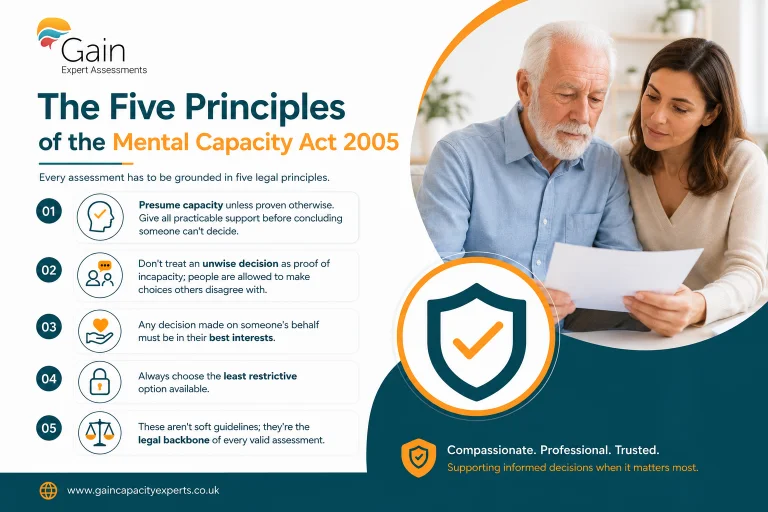
Every assessment has to be grounded in five legal principles.
- Presume capacity unless proven otherwise. Give all practicable support before concluding someone can’t decide.
- Don’t treat an unwise decision as proof of incapacity; people are allowed to make choices others disagree with.
- Any decision made on someone’s behalf must be in their best interests.
- Always choose the least restrictive option available.
- These aren’t soft guidelines; they’re the legal backbone of every valid assessment.
Factors That Can Influence Capacity After Stroke
Capacity assessments after stroke have to account for more than the stroke itself. Aphasia, fatigue, delirium, medication side effects, depression, anxiety, pain, and even a noisy unfamiliar hospital ward can all temporarily distort how someone presents. I’ve seen assessments delayed by a week simply because a patient was clearly exhausted and confused by 4pm and reassessed in the morning with a completely different result. Good assessors account for this. Rushed ones don’t.
Can Mental Capacity Improve After a Stroke?
Often, yes. The brain has a genuine capacity for neuroplasticity, rebuilding pathways around damaged areas over weeks and months. Speech and language therapy, occupational therapy, and structured cognitive rehabilitation can all support real functional recovery. This is exactly why capacity should never be treated as a one-time verdict. A person assessed as lacking capacity for a financial decision in month one might genuinely regain that capacity by month six, and the law expects reassessment to reflect that.
How Families Can Support Someone After a Stroke
Small adjustments make a real difference here. Give extra time before expecting an answer. Reduce background noise and distractions during important conversations. Use visual aids or written summaries alongside spoken explanations, especially where aphasia is present. Encourage independence wherever it’s safely possible rather than stepping in too fast. And know when a situation has moved past what a family can judge alone, that’s when bringing in a professional assessment protects everyone, including the person you’re trying to help.
What Happens If Someone Lacks Mental Capacity?
If an assessment genuinely concludes someone lacks capacity for a specific decision, the law requires a best interests decision made on their behalf, considering their past wishes, values, and views wherever known. Depending on the situation, this might involve an attorney appointed under a lasting power of attorney, a court-appointed deputy, the Court of Protection for disputed or high-value matters, or an independent mental capacity advocate where the person has no family to consult.
When Should You Arrange an Independent Mental Capacity Assessment?
If a decision is disputed within the family, involves significant money or property, or feeds into court proceedings, an independent assessment gives everyone, including the person at the center of it, a fair and properly documented process. It’s worth arranging before a decision is contested, not after.
Common Myths About Mental Capacity After a Stroke
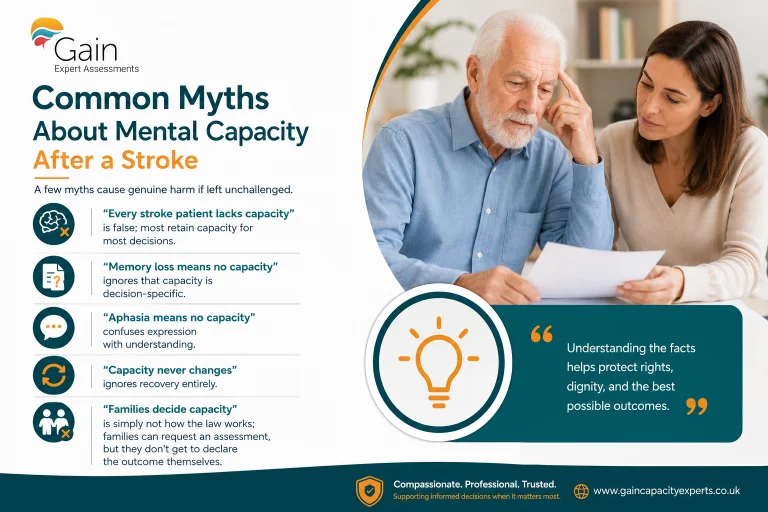
A few myths cause genuine harm if left unchallenged. “Every stroke patient lacks capacity” is false; most retain capacity for most decisions. “Memory loss means no capacity” ignores that capacity is decision-specific. “Aphasia means no capacity” confuses expression with understanding. “Capacity never changes” ignores recovery entirely. And “families decide capacity” is simply not how the law works; families can request an assessment, but they don’t get to declare the outcome themselves.
Where we are Located
Stroke changes things fast, and decisions about a loved one’s care, finances or property often can’t wait for things to settle. We get that. Gain Capacity Experts carries out independent, court ready mental capacity assessments across England and Wales, and our assessors genuinely understand stroke recovery, aphasia and how unpredictable that rehabilitation timeline can actually be. You don’t have to guess your way through this.
Reach us at Office 17 The Grove, Peache Way, Bramcote, Nottingham NG9 3DX, or call our team directly to talk through what’s happening in your case.
Why an Independent, Specialist Assessment Matters
This is where I’ll be straightforward, because I think families deserve that rather than a sales pitch. A rushed capacity assessment, done by someone unfamiliar with stroke-related communication difficulties, can get this badly wrong in both directions, wrongly removing someone’s autonomy or wrongly leaving a vulnerable person exposed. An independent assessor who understands aphasia, fatigue, and the genuine pace of stroke recovery produces a report that actually holds up, whether it’s for a solicitor, a court, or simply your own peace of mind. If you’re weighing up a mental capacity assessment for a family member or need a Lasting Power of Attorney assessment or testamentary capacity assessment done properly, getting it right the first time saves real stress later.
Conclusion
A stroke can genuinely affect how someone thinks, remembers, and communicates, but it never automatically removes their mental capacity. Capacity is always specific to one decision, at one moment in time, and it’s protected by a presumption in the person’s favor under the Mental Capacity Act 2005. Recovery can restore capacity that seemed lost in the early weeks, which is exactly why reassessment matters so much. If you’re a family member facing one of these decisions right now, the honest next step is simple: don’t guess, and don’t assume. Get a proper assessment from someone who understands stroke recovery, not just the legal checklist. What would change for your family if you knew, with real confidence, exactly what your loved one is and isn’t able to decide right now?