
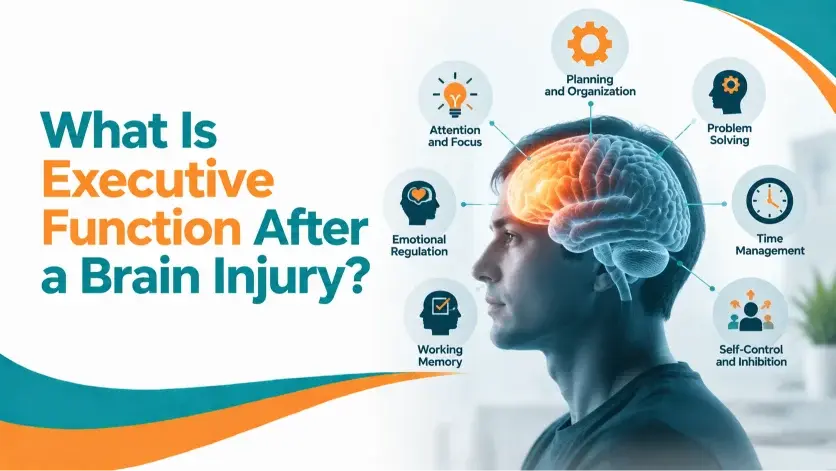
A brain injury can change the way a person plans, judges risk, solves problems and makes decisions, even when their speech or memory appear normal. A neuropsychological assessment can help identify these less obvious changes, explain their effect on everyday life and guide rehabilitation, care, legal decisions or further mental capacity assessment.
What Is Executive Function After a Brain Injury?
Executive function is a group of thinking skills that help a person organise behaviour and complete everyday tasks. These skills include planning, problem solving, attention, self-control, flexible thinking, reasoning, starting tasks, monitoring performance and recognising mistakes.
NICE notes that executive function problems are common after acquired brain injury and may not always be obvious, particularly in familiar or structured situations. This is one reason a person may appear capable during a short conversation while struggling with more complex tasks at home, work or in the community.
Which Everyday Skills Depend on Executive Function?
Executive skills are used when someone organises appointments, manages money, follows a recipe, plans a journey, deals with unexpected problems or completes work tasks. They also help people control impulses, consider consequences and change their approach when something is not working.
Why Can Executive Dysfunction Be Difficult to Notice?
Executive dysfunction is not always as visible as physical disability or severe memory loss. A person may communicate clearly, remember basic information and perform well during simple tasks, yet have difficulty using information when a situation becomes complex.
This difference between what a person can say and what they can do in real life is important. NICE recommends using both standard cognitive tests and functional assessments when examining cognitive strengths and weaknesses.
Are Executive Functions Linked to the Frontal Lobes?
Executive functions are strongly associated with the frontal areas of the brain, although complex thinking depends on wider brain networks. Injury affecting these systems may cause problems with planning, inhibition, judgement, motivation, emotional control or awareness of difficulties.
What Are the Signs of Executive Dysfunction After Brain Injury?
Executive dysfunction can affect each person differently depending on the injury, previous abilities, environment and other health factors. Families and professionals may notice changes in behaviour before the injured person recognises them.
| Executive difficulty | Possible everyday example |
| Planning | Unable to organise several tasks in the correct order |
| Problem solving | Becomes stuck when the original plan fails |
| Impulse control | Makes quick decisions without considering consequences |
| Attention | Loses track during longer or more complex tasks |
| Flexible thinking | Struggles when plans or routines change |
| Self-monitoring | Does not recognise repeated mistakes |
| Initiation | Understands what needs doing but does not start |
| Judgement | Underestimates risk or makes unsafe choices |
| Social cognition | Misreads social situations or other people’s reactions |
These signs do not prove that someone has executive dysfunction. They show that a fuller assessment may be useful when the difficulties are persistent or affecting independence.
Why Can Executive Problems Be Missed During Routine Assessments?
Brief assessments take place in controlled settings where instructions are clear and distractions are limited. Real life is less structured and often requires the person to plan, prioritise, switch attention and recognise problems without prompting.
NICE therefore recommends looking beyond test scores alone. Assessment should consider factors such as processing speed, attention, working memory, learning, memory, executive function and social cognition, alongside functional ability.
Why Does Information From Family and Professionals Matter?
People who spend regular time with the person may notice changes that are difficult to reproduce during an appointment. Their observations can help explain whether the person is struggling with finances, routines, safety, work, relationships or other daily responsibilities.
This information should not replace direct assessment. It provides context that can be considered alongside medical records, clinical findings and the person’s own account.
What Is a Neuropsychological Assessment?
A neuropsychological assessment examines how brain function relates to thinking, behaviour and everyday ability. It can help identify cognitive strengths and difficulties after traumatic brain injury, stroke and other acquired neurological conditions.
NICE recommends that cognitive assessment includes areas such as orientation, processing speed, visual and spatial skills, language, attention, working memory, learning, memory, executive function and social cognition where relevant.
What Happens During a Neuropsychological Assessment?
The exact process depends on the reason for referral. The assessor may review medical information, discuss current difficulties, complete structured cognitive tasks and consider how the findings relate to everyday activities.
A proper assessment is not simply a set of scores. Results need to be interpreted alongside the person’s background, previous abilities, injury, emotional wellbeing and functional performance.
Can Mood, Fatigue or Pain Affect Cognitive Testing?
Yes. NICE advises professionals to consider factors such as emotional distress, low mood, anxiety and psychological trauma because these can affect cognitive function.
Fatigue, pain, medication, sleep and other health conditions may also influence how a person performs. These factors should be considered when the findings are interpreted.
When Is a Neuropsychological Assessment Needed After Brain Injury?
A neuropsychological assessment may be useful when there are continuing concerns about thinking, behaviour or functional ability after a brain injury. It may also be appropriate when the person’s difficulties cannot be explained fully by routine medical examination or basic cognitive screening.
Common reasons for considering an assessment include:
- problems with planning or organisation
- reduced judgement or risk awareness
- unexplained changes in behaviour
- difficulty returning to work or education
- problems managing complex daily tasks
- concerns about memory or concentration
- poor awareness of difficulties
- rehabilitation planning
- personal injury or clinical negligence matters
- questions about independence or support needs
- concerns that may require a separate mental capacity assessment
The decision to arrange an assessment should be based on the individual situation rather than the diagnosis alone.
When Should Solicitors Consider a Neuropsychological Assessment?
Solicitors may consider neuropsychological evidence when a brain injury appears relevant to the person’s cognitive functioning, behaviour, rehabilitation needs or ability to manage complex tasks. The exact expert required will depend on the questions that need to be answered.
Clear instructions are important in medico-legal work. The expert should understand the issues they are being asked to address and should remain within their professional area of expertise.
What Is the Difference Between a Neuropsychological Assessment and a Mental Capacity Assessment?
These assessments may overlap, but they answer different questions. A neuropsychological assessment examines cognitive functioning, while a mental capacity assessment considers whether the person can make a particular decision under the relevant legal framework.
| Neuropsychological assessment | Mental capacity assessment |
| Examines cognitive functioning | Examines capacity for a specific decision |
| May assess memory, attention and executive skills | Applies the relevant legal capacity test |
| Identifies cognitive strengths and difficulties | Determines whether capacity is present for that decision |
| Can guide rehabilitation | Can support legal or welfare decision making |
| May help explain functional problems | Must be decision-specific |
Under the Mental Capacity Act 2005, which applies in England and Wales, a person should be presumed to have capacity unless it is established otherwise. A brain injury or cognitive diagnosis alone does not mean the person lacks capacity.
Can Executive Dysfunction Affect Mental Capacity?
It can, but executive dysfunction does not automatically mean someone lacks capacity. Capacity must be assessed in relation to the particular decision the person needs to make.
Brain injury may become relevant where difficulties affect the person’s ability to understand, retain, use or weigh relevant information, or communicate a decision. The assessor must examine the actual decision rather than relying only on a diagnosis or cognitive test result.

Why Can the Ability to Use and Weigh Information Matter?
A person may be able to repeat information correctly but still struggle to compare options, recognise consequences or apply that information to their own situation. In some brain injury cases, this difference may be particularly important when complex financial, welfare or legal decisions are involved.
A separate, properly structured mental capacity assessment may therefore be needed if the concern relates to a specific decision.
How Is Executive Function Assessed in Real Life?
A good assessment looks at both structured cognitive performance and everyday functioning. NICE specifically recommends combining standard cognitive tests with functional assessment rather than relying on one type of evidence alone.
Standard Cognitive Testing
Structured tests may examine abilities such as attention, processing speed, memory, problem solving, mental flexibility and inhibition. The choice of tests should match the referral question and the person’s needs.
Functional Assessment
Functional assessment considers how cognitive problems affect daily activities. This could include work, household tasks, appointments, money management, travel, routines or other activities relevant to that person.
Clinical Interview and Background Information
The assessor may also review medical history, rehabilitation records and the person’s description of their difficulties. Information from relatives or professionals may be considered where appropriate.
What Can a Neuropsychological Assessment Help Explain?
The assessment may help explain whether cognitive problems are present, which areas appear affected and how those difficulties may influence daily functioning. It can also identify abilities that remain strong and can be used during rehabilitation.
Findings may support decisions about rehabilitation, care, work, education, independent living or the need for further specialist assessment.
Can Neuropsychological Assessment Help With Rehabilitation?
Yes. Understanding the person’s cognitive profile can help professionals choose more suitable rehabilitation strategies and identify where support is needed.
NICE recommends that cognitive rehabilitation planning considers the results of assessment, the interaction between different cognitive abilities and the person’s own needs and preferences.
A person with memory difficulties may need one type of support, while someone with good memory but poor planning or self-monitoring may need a very different approach.
Can a Person Have Executive Dysfunction Even If Their Memory Seems Good?
Yes. Executive function and memory are related but they are not the same thing.
Someone may remember information well but struggle to organise it, compare options or use it effectively when making a decision. This is why a fuller cognitive assessment can be helpful when daily behaviour does not match the results of a short screening test.
Does a Normal Brain Scan Rule Out Executive Problems?
No. Imaging and neuropsychological assessment answer different questions.
Brain imaging can provide information about physical changes in the brain, while neuropsychological assessment looks at cognitive and functional performance. Clinical interpretation should consider the wider evidence rather than treating one test as the complete answer.
Who Should Carry Out a Neuropsychological Assessment?
NICE recommends that cognitive assessments are overseen and interpreted by a registered practitioner with expertise in neuropsychology and an understanding of the person and their neurological condition or injury.
The appropriate professional may depend on the case, referral question and level of specialist input required.

What Information Should Be Available Before the Assessment?
Useful records may include hospital discharge information, neurology reports, previous neuropsychology reports, rehabilitation records, GP information and details of medication. Information about education, employment, previous functioning and current care may also provide important context.
For legal matters, the letter of instruction should clearly identify the questions the expert is being asked to consider.
What Happens After a Neuropsychological Assessment?
The assessor usually brings the available evidence together and explains the findings in a clinical or medico-legal report, depending on the purpose of the assessment. Recommendations may cover rehabilitation, further investigation, support or referral to another professional.
Where a specific question about mental capacity remains, a separate capacity assessment may be required. Neuropsychological findings can provide useful clinical evidence, but they do not automatically decide the legal capacity question.
Neuropsychological Assessment and Brain Injury Cases in England and Wales
Brain injury cases often involve more than one professional issue. Cognitive function, care needs, rehabilitation, mental capacity and psychological health may all need consideration.
Gain Expert Assessments provides multidisciplinary assessment services across England and Wales, including neuropsychology, brain injury capacity work, psychiatry and independent social work. Its existing brain injury service considers executive functioning and how cognitive changes affect real-world decision making.
When Should You Seek Professional Assessment?
Professional assessment may be appropriate when cognitive or behavioural changes continue to affect daily life, safety, rehabilitation or important decisions. It may also be useful when relatives and professionals can see a clear difference between the person’s apparent ability and their actual day-to-day functioning.
Early identification can help the wider team understand the problem and decide what support or assessment should come next.
Getting the Right Assessment After Brain Injury
Brain injury can affect thinking and behaviour in ways that are easy to overlook during a short appointment. A neuropsychological assessment can provide a clearer picture of executive function, cognition and real-world ability when ordinary screening does not answer the important questions.
Gain Expert Assessments provides independent multidisciplinary assessments across England and Wales for solicitors, families and professionals dealing with brain injury, mental capacity and complex cognitive concerns. An appropriate assessment can help identify what is happening, how it affects daily life and what evidence or support may be needed next.