
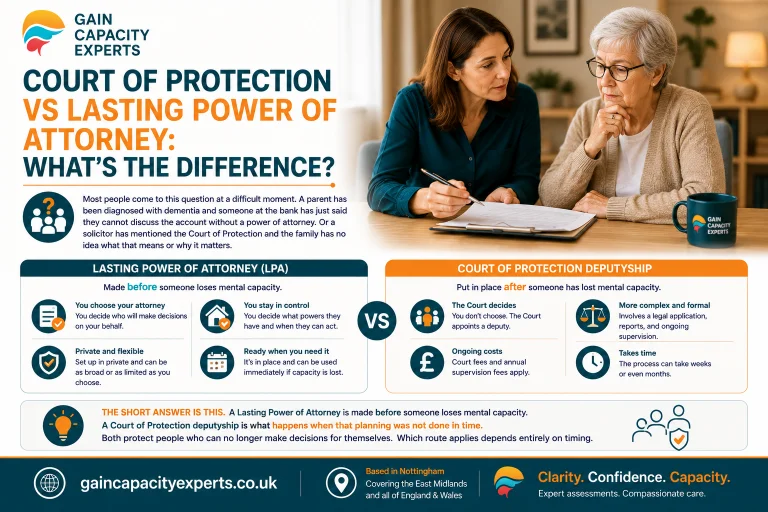
Most people come to this question at a difficult moment. A parent has been diagnosed with dementia and someone at the bank has just said they cannot discuss the account without a power of attorney. Or a solicitor has mentioned the Court of Protection and the family has no idea what that means or why it matters.
The short answer is this. A Lasting Power of Attorney is made before someone loses mental capacity. A Court of Protection deputyship is what happens when that planning was not done in time. Both protect people who can no longer make decisions for themselves. Which route applies depends entirely on timing.
What Is Lasting Power of Attorney?
A Lasting Power of Attorney is a legal document made under the Mental Capacity Act 2005. The person making it is called the donor. They appoint one or more people, called attorneys, to make decisions on their behalf if they lose the mental capacity to do so themselves in the future. There are two types, and the distinction between them matters more than most people realise.
Property and Financial Affairs LPA
A Property and Financial Affairs LPA covers decisions about bank accounts, bills, pensions, investments, and property. Importantly, this type is used before the donor loses capacity, if the donor chooses to allow that when setting it up. Some people find it useful to have a trusted family member helping with finances while they are still well. Others prefer to restrict it so it can only be used once they have lost capacity. Both approaches are valid.
Health and Welfare LPA
A Health and Welfare LPA covers decisions about medical treatment, daily care, where someone lives, and who looks after them. This type can only be used once the donor has lost the capacity to make those decisions themselves. It cannot be activated while the donor still has capacity, regardless of what is written in the document.
Both types must be registered with the Office of the Public Guardian before they are valid. Registration currently takes approximately 20 weeks, though this reflects current processing times and can vary. That waiting period matters more than most people appreciate. An LPA that has been signed but not yet registered cannot be used, even in an emergency. Registering early, while the donor is well, is almost always the right approach.
Attorneys can be appointed to act together on every decision, or independently of each other, or jointly on some decisions and independently on others. Replacement attorneys can also be named in case a first-choice attorney is unable to act. The donor can include specific instructions or preferences about how decisions should be made.
The key point about an LPA is control. The donor chooses who acts for them. They can set boundaries. They can include their wishes. None of that is available once capacity is lost.
Not sure whether an LPA can still be made in your situation? Call Gain Capacity Experts on 0330 380 2184 for an initial conversation. We carry out LPA assessments and COP3 assessments across England and Wales.
What Is Court of Protection Deputyship?
When someone loses mental capacity, and no Lasting Power of Attorney is registered, the only legal route available in England and Wales is an application to the Court of Protection.
We have seen this situation more times than we can count. A parent develops dementia. The family assumes someone will just be able to step in. Then the bank says no. The care home needs authorisation. The bills are not getting paid. And the family discovers that without a registered LPA, nobody has any legal authority to do anything at all.
And then a deputyship application becomes necessary. The Court of Protection appoints someone called a deputy to make decisions on the person’s behalf. That deputy is usually a close family member, though it can be a friend, a professional, or in some cases a solicitor. The Court decides who gets appointed. The person who has lost capacity has no say in that. This is one of the most significant differences between this route and an LPA. There are two types of deputyship.
Property and affairs deputyship deals with financial decisions and is by far the most common. Health and welfare deputyship is a different matter entirely. Courts grant it rarely, and only in specific circumstances where there is an ongoing dispute about welfare decisions that cannot be resolved any other way. Families who expect to receive full welfare decision-making authority through a deputyship are often surprised to find the Court will not grant it.
Once appointed, the deputy does not have the same freedom of movement as an attorney under an LPA. Many significant decisions, like selling a property, for example, or making substantial gifts from the person’s money, require the deputy to go back to the Court for specific permission. This adds time and cost.
Deputies are supervised by the Office of the Public Guardian for the full duration of the deputyship. Annual accounts must be submitted every year. A security bond, essentially an insurance policy protecting the person’s assets, is usually required of property and affairs deputies. These are ongoing obligations that last as long as the deputyship continues.
How long does the application take? Realistically, approximately 6 to 9 months for a straightforward case from application to order. That is not a worst-case figure. It is the typical experience. During that entire period, nobody has legal authority to manage the person’s affairs. Urgent matters like a bill that needs paying, a care arrangement that needs funding, can be extremely difficult to deal with.
The Consequences of Having Neither in Place
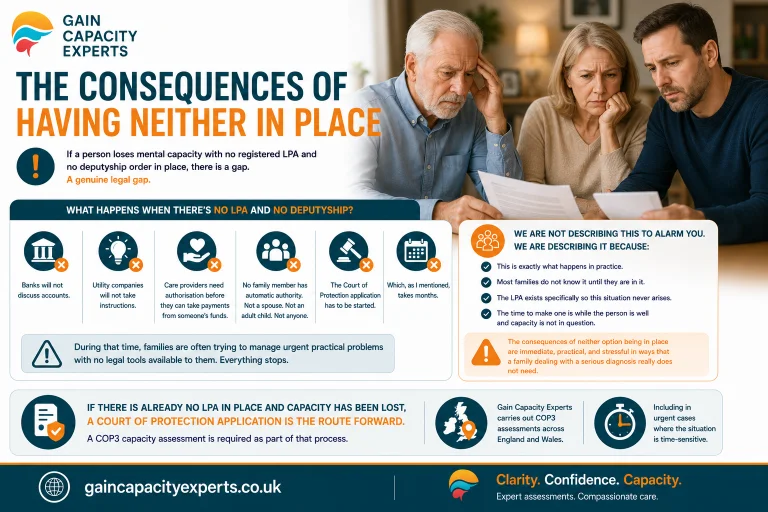
This is the part families wish someone had told them sooner. If a person loses mental capacity with no registered LPA and no deputyship order in place, there is a gap. A genuine legal gap. No family member has automatic authority to access a bank account, pay bills, manage a pension, or make care decisions. Not a spouse. Not an adult child. Not anyone.
Banks will not discuss accounts. Utility companies will not take instructions. Care providers need authorisation before they can take payments from someone’s funds. Everything stops. The Court of Protection application has to be started. Which, as I mentioned, takes months. During that time, families are often trying to manage urgent practical problems with no legal tools available to them.
We are not describing this to alarm you. We are describing it because this is exactly what happens in practice, and most families do not know it until they are in it. The LPA exists specifically so this situation never arises. The time to make one is while the person is well and capacity is not in question.
The consequences of neither option being in place are immediate, practical, and stressful in ways that a family dealing with a serious diagnosis really does not need.
If there is already no LPA in place and capacity has been lost, a Court of Protection application is the route forward. A COP3 capacity assessment is required as part of that process. Gain Capacity Experts carries out COP3 assessments across England and Wales, including in urgent cases where the situation is time-sensitive.
Whatever stage you are at, the first step is understanding where you stand. Call 0330 380 2184 to speak with our team.
Key Differences at a Glance
The two frameworks look similar on the surface. Both involve someone making decisions on behalf of a person who lacks capacity. The differences in practice are significant. Here is a direct comparison.
| Aspect | Lasting Power of Attorney | Court of Protection Deputyship |
|---|---|---|
| When It Can Be Made | While the donor has capacity | After capacity has been lost |
| Who Decides | The donor chooses their attorney | The Court appoints a deputy |
| Time to Set Up | Around 20 weeks (OPG registration) | Around 6 to 9 months |
| Ongoing Supervision | None required | Annual accounts, supervision fees, security bond |
| Powers Available | Broad, set by the donor | Restricted, Court permission needed for major decisions |
| Court Involvement | None after registration | Ongoing throughout |
| What It Covers | Finance, health and welfare, or both | Primarily financial affairs |
Can Someone with Dementia Still Make an LPA?
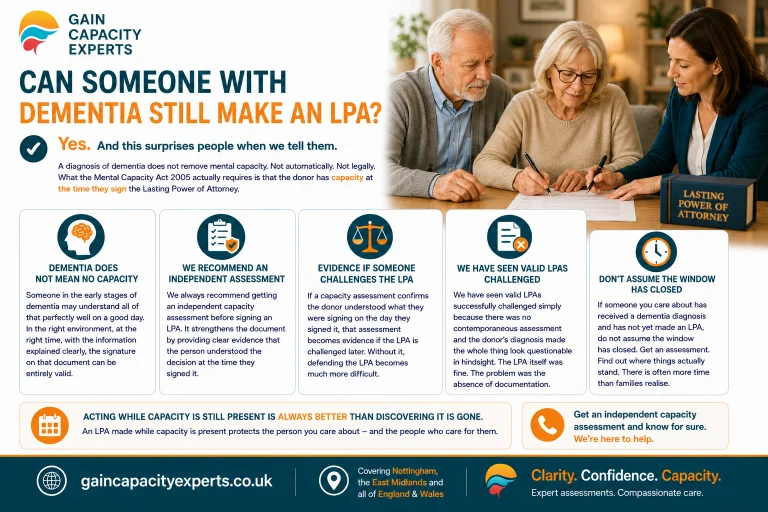
Yes. And this surprises people when we tell them. A diagnosis of dementia does not remove mental capacity. Not automatically. Not legally. What the Mental Capacity Act 2005 actually requires is that the donor has capacity at the time they sign the Lasting Power of Attorney. That means they understand what the document is, who they are appointing as their attorney, and what powers they are giving that person.
Someone in the early stages of dementia may understand all of that perfectly well on a good day. In the right environment, at the right time, with the information explained clearly, the signature on that document can be entirely valid.
We always recommend getting an independent capacity assessment before signing an LPA. It strengthens the document by providing clear evidence that the person understood the decision at the time they signed it.
If a capacity assessment carried out by a qualified independent practitioner confirms that the donor understood what they were signing on the day they signed it, that assessment becomes evidence. If someone challenges the LPA later, for example a family member who disagrees with the choice of attorney, that assessment provides important evidence. Without it, defending the LPA becomes much more difficult.
We have seen valid LPAs successfully challenged simply because there was no contemporaneous assessment and the donor’s diagnosis made the whole thing look questionable in hindsight. The LPA itself was fine. The problem was the absence of documentation.
If someone you care about has received a dementia diagnosis and has not yet made an LPA, do not assume the window has closed. Get an assessment. Find out where things actually stand. There is often more time than families realise, and acting quickly when capacity is still present is always better than discovering it is gone.
Gain Capacity Experts carries out LPA assessments across England and Wales, including for people with a recent dementia diagnosis where the picture is uncertain. Home visits and virtual assessments are both available.
If you are not sure whether an LPA can still be made, call 0330 380 2184. A conversation costs nothing and it is the fastest way to understand where you stand.
The Role of Capacity Assessment in Both Processes
People often ask whether a capacity assessment is really necessary, or whether a letter from the GP is enough. It depends on what the assessment is for and how complicated the situation is.
For an LPA, a formal assessment is not a legal requirement in straightforward cases where capacity is clear. But the moment there is any doubt like a diagnosis, a family concern, or a recent behaviour change, then an independent assessment is the sensible thing to do. It confirms the donor understood what they were signing. It creates a contemporaneous record. And if the LPA is ever questioned, it is the document that makes the difference between the LPA holding and the LPA being challenged successfully.
A GP letter is not the same thing. A GP has a general picture of someone’s health over time. An independent capacity assessor carries out a structured evaluation specifically for this purpose, applying the two-stage test under the Mental Capacity Act 2005. Those are different exercises producing different quality of evidence.
For a Court of Protection deputyship application, the position is clearer. A COP3 form must be completed as part of every application. There is no flexibility on this. The COP3 requires a qualified practitioner to confirm that the person lacks capacity for the specific decisions covered by the deputyship application, applying the correct legal test. It is not a general medical statement. It is a structured legal document.
Who completes it matters. In a straightforward, uncontested case, a GP may be willing to complete the COP3. In a complex case, a contested case, or a case where the person’s condition is unusual, or the clinical picture is disputed, a GP statement will often not be sufficient. A specialist independent assessment from someone with the relevant clinical expertise is what the Court actually needs to see.
Get the wrong evidence and the application stalls. Sometimes for months. Gain Capacity Experts carries out COP3 assessments across England and Wales. The team includes psychiatrists, occupational therapists, social workers, and dementia specialists matched to the clinical presentation of each case. Reports are written to the standard the Court of Protection expects.
If a deputyship application is already underway and you need a COP3 assessment, or if you are about to start the process and want to understand what is needed, call 0330 380 2184 or contact our team.
What About an Enduring Power of Attorney?
If you are dealing with an elderly relative’s affairs and you have found a signed document called an Enduring Power of Attorney, it is worth understanding what you actually have in your hands.
Enduring Powers of Attorney predate the Mental Capacity Act 2005. They were the legal instrument used before October 2007 to appoint someone to manage financial affairs if the maker lost capacity. When the Mental Capacity Act came into force, EPAs were replaced by the two types of Lasting Power of Attorney we use today. No new EPA can be created. But the ones that were made before 1 October 2007 remain valid. We still see them regularly, particularly when we are working on cases involving people in their eighties and nineties.
There is one important practical point. If the person who made the EPA is now losing or has lost capacity, the EPA must be registered with the Office of the Public Guardian before it can be used. An unregistered EPA sitting in a drawer is not something the attorney can act on. Registration is the step that activates it. If you find an EPA, register it without delay. The process is straightforward and the OPG will guide you through it. Do not assume that because the document exists, the attorney is already able to act.
One more thing worth knowing: an EPA only ever covered property and financial decisions. It has no equivalent to the Health and Welfare LPA. So even if a valid EPA is in place and registered, decisions about medical treatment or care arrangements are not covered by it. For those decisions, the family either needs to work within the best interests framework under the Mental Capacity Act 2005, or in some cases apply to the Court of Protection.
Which Route Applies to Your Situation?
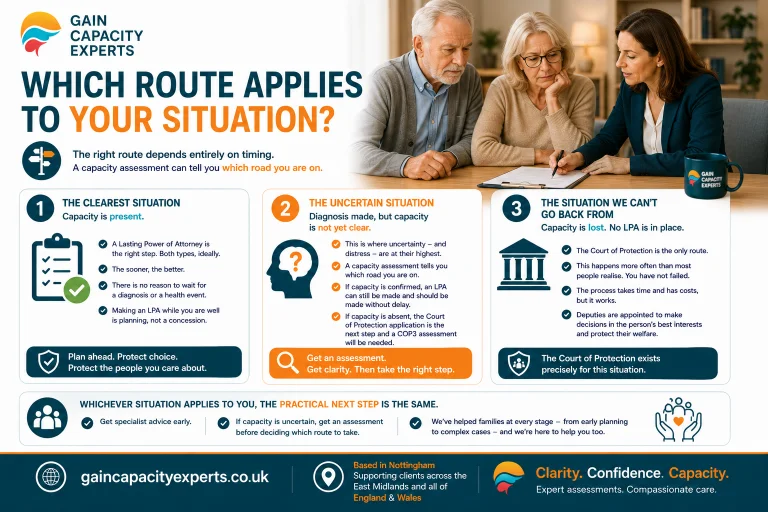
The clearest situation is where the person still has mental capacity. In that case, a Lasting Power of Attorney is the right step. Both types, ideally. The sooner the better. There is no reason to wait for a diagnosis or a health event. Making an LPA while you are well is no different from making a will while you are well. It is planning, not a concession to anything.
The harder situation is where a diagnosis has already been made but it is not entirely clear whether capacity has been lost. This is where we see the most uncertainty and, honestly, the most distress. Families are not sure whether to push ahead with an LPA or start a Court of Protection application. The answer is that a capacity assessment tells you which road you are on. If capacity is confirmed, the LPA can still be made and should be made without delay. If capacity is absent, the Court of Protection application is the next step and a COP3 assessment will be needed as part of it.
The third situation is the one we cannot go back from. Capacity has been lost. No LPA is in place. The Court of Protection is the only route. This is where families often feel they have failed somehow. They have not. It happens more often than most people realise, and the Court of Protection exists precisely for this situation. The process takes time and it has costs attached, but it works. Deputies do protect the people they are appointed to look after.
Whichever situation applies to you, the practical next step is the same. Get specialist advice early. If capacity is uncertain, get an assessment before making any decisions about which route to take. We have helped families at every stage of this, including cases where the situation looked more complicated than it turned out to be, and cases where there was more time available than anyone had expected.
If you are not sure where you stand, call us on 0330 380 2184. We cover England and Wales with home visits and virtual assessments available. The first conversation is always about understanding your specific situation, not about selling you a service.