
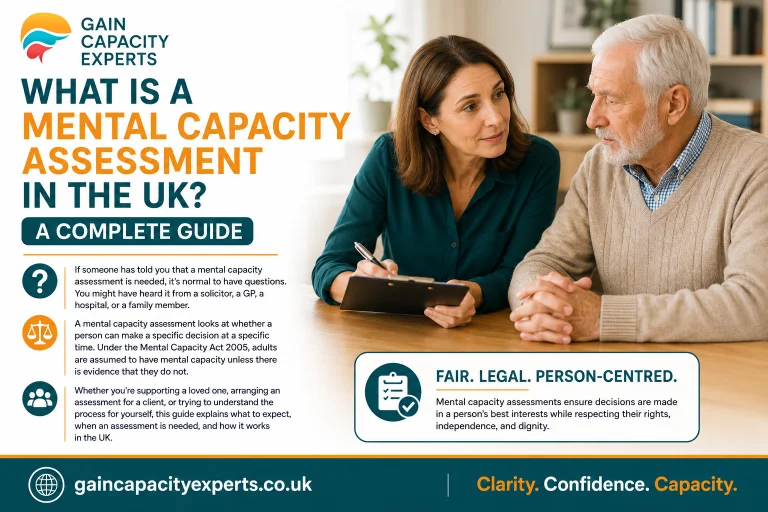
If someone has told you that a mental capacity assessment is needed, it’s normal to have questions. You might have heard it from a solicitor, a GP, a hospital, or a family member. Many people worry that it means someone is about to lose the right to make their own decisions. That isn’t what the assessment is for.
A mental capacity assessment looks at whether a person can make a specific decision at a specific time. Under the Mental Capacity Act 2005, adults are assumed to have mental capacity unless there is evidence that they do not. The assessment helps confirm that in a fair and structured way.
Whether you’re supporting a loved one, arranging an assessment for a client, or trying to understand the process for yourself, this guide explains what to expect, when an assessment is needed, and how it works in the UK.
What Is a Mental Capacity Assessment?
A mental capacity assessment checks whether someone understands and can make a particular decision for themselves. It does not decide whether a person is “capable” in general. Instead, it looks at one decision at a time that needs to be made. In England and Wales, the process follows the Mental Capacity Act 2005.
This is where many people get confused. Someone might understand where they want to live but struggle to make decisions about managing their finances. Both situations can exist at the same time. Capacity also changes. A person who cannot make a decision today may be able to make it later if their condition improves.
If you need a mental capacity assessment for a legal matter, property transaction, or family situation, speak to the team at Gain Capacity Experts on 0330 380 2184 for an initial conversation.
The Legal Framework And The Mental Capacity Act 2005
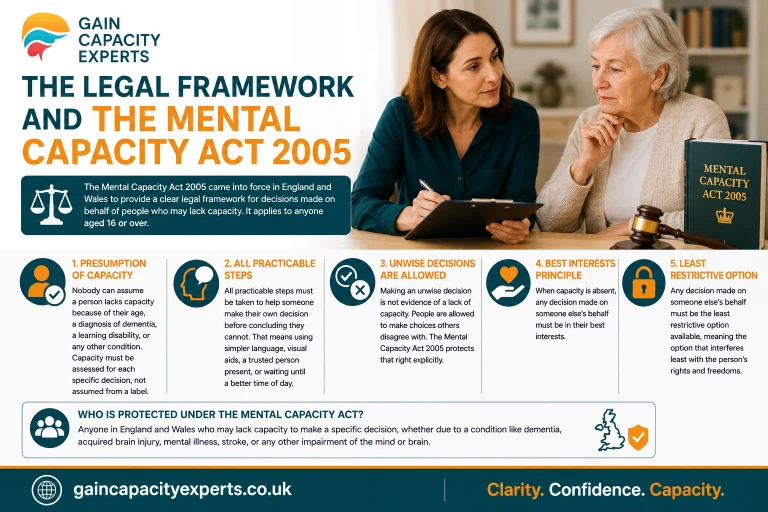
The Mental Capacity Act 2005 came into force in England and Wales to provide a clear legal framework for decisions made on behalf of people who may lack capacity. It applies to anyone aged 16 or over.
The first principle is the presumption of capacity. Nobody can assume a person lacks capacity because of their age, a diagnosis of dementia, a learning disability, or any other condition. Capacity must be assessed for each specific decision, not assumed from a label.
The second principle is that all practicable steps must be taken to help someone make their own decision before concluding they cannot. That means using simpler language, visual aids, a trusted person present, or waiting until a better time of day.
The third principle surprises many families. Making an unwise decision is not evidence of a lack of capacity. People are allowed to make choices others disagree with. The Mental Capacity Act 2005 protects that right explicitly.
The fourth and fifth principles apply when capacity is found to be absent. Any decision made on someone else’s behalf must be in their best interests and be the least restrictive option available, meaning the option that interferes least with the person’s rights and freedoms.
Who is protected under the Mental Capacity Act? Anyone in England and Wales who may lack capacity to make a specific decision, whether due to a condition like dementia, acquired brain injury, mental illness, stroke, or any other impairment of the mind or brain.
The Two-Stage Test: How Capacity Is Actually Assessed
Every mental capacity assessment in England and Wales uses the same two-stage test set out in the Mental Capacity Act 2005. Both stages must be satisfied before a person can be assessed as lacking capacity for a specific decision.
Stage one asks: is there an impairment or disturbance in the functioning of the person’s mind or brain? This could be dementia, a stroke, a learning disability, acquired brain injury, a mental illness, or even a temporary state such as delirium or the effects of medication. This stage identifies whether there is a potential cause for reduced capacity.
Stage two asks: does that impairment mean the person is unable to make this specific decision? To answer this, the assessor looks at four elements. Can the person understand the relevant information, when it is explained to them? Can they retain it long enough to use it in making the decision? Can they weigh up the options, considering the risks, benefits, and consequences? And can they communicate their decision in any way, whether through speech, writing, gesture, or other means?
All four elements matter. A person who understands and weighs up the information but cannot communicate their answer still has their capacity supported through other means before a conclusion is reached.
A person with dementia may retain full capacity to decide where they want to live, who they want to see, or what they want to eat and lack capacity to manage a property sale or set up a Lasting Power of Attorney. A proper assessment looks at the specific decision in front of it, not the person’s diagnosis in general.
The 4 stages of mental capacity assessment that practitioners sometimes refer to follow this same framework: identifying the decision, establishing whether there is an impairment, applying the functional test across the four elements, and then documenting the reasoning clearly.

What Happens During a Mental Capacity Assessment?
The process is structured, but it is also led by the person being assessed. Everything is adapted to how that person communicates and what they find comfortable.
Before the assessment, the assessor reviews background information, including medical history, care records, and any relevant reports. This matters because a good assessor arrives informed, not blank. They are not meeting the person cold.
The assessment itself takes place wherever the person is most at ease. At home, in a care setting, or virtually if that works better. Gain Capacity Experts offers home visits and virtual assessments across England and Wales because where someone feels comfortable directly affects how they present.
During the session, the assessor explains the specific decision in plain terms. Then they ask questions. Not a fixed script, but questions that genuinely test whether the person can understand what is being asked, hold on to the information, think through the options, and express their view in any way that works for them. Sign language, gestures, and pointing all count.
Family members sometimes ask whether they can be present. The short answer is yes, though the assessor may speak with the person alone at some point to ensure the responses are genuinely the person’s own.
How long does a mental capacity assessment take?
It varies. A straightforward assessment for a single decision might take 30 to 45 minutes. Complex cases involving communication difficulties, fluctuating capacity, or multiple decisions can take considerably longer and may require more than one visit.
After the assessment, the assessor produces a written report. A good report does not just state a conclusion. It shows the reasoning behind what was asked, how the person responded, and why the assessor reached the view they did. For legal proceedings, that reasoning is what matters. The multidisciplinary team at Gain Capacity Experts is trained to produce reports that hold up under scrutiny, not just satisfy an administrative requirement. 72-hour turnaround is available in certain areas, including Greater Manchester, for situations where time is short.
Who Can Carry Out a Mental Capacity Assessment?
For straightforward day-to-day decisions, any health or social care professional involved in a person’s care can carry out the assessment. A nurse, a GP, or a social worker. The decision about what to eat or whether to take a specific medication does not require a specialist.
Complex decisions are different. When a decision involves the Court of Protection, a contested LPA, an estate dispute, or any situation where the assessment may be challenged, the person carrying it out needs to meet a higher standard. They need the relevant clinical expertise for that person’s condition. They need to understand the legal framework well enough to produce a report that satisfies a court. And they need to be independent, with no conflict of interest in the outcome.
Who can assess mental capacity for these situations?
The assessor might be a psychiatrist, a clinical psychologist, an occupational therapist, a social worker, or a registered nurse with specialist expertise. A dementia specialist for someone with cognitive decline, a psychiatrist for someone with a mental health condition, or a neuropsychologist for someone with a brain injury.
Victoria Sample, founder of Gain Capacity Experts, spent 20 years working in NHS settings including secure hospitals and community services for older adults with learning disabilities. That background shapes how the team approaches every assessment. Not just the legal framework. The clinical reality underneath it.
For complex or contested cases, an independent specialist assessment from someone with that depth of experience produces a different kind of report. That difference matters in proceedings where the report will be scrutinised.
Need a specialist assessment for a complex or contested decision? Contact our team to discuss your case. We cover England and Wales with home visits and virtual assessments available.
Independent Assessment vs Statutory Assessment
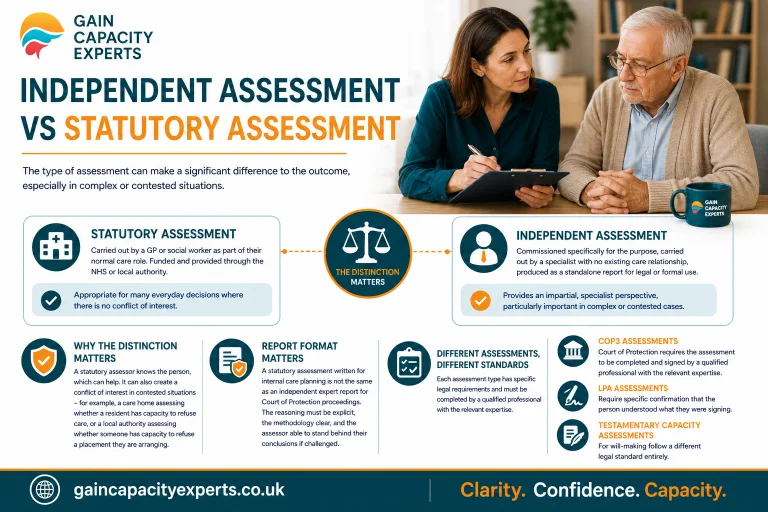
When a GP or social worker carries out a capacity assessment as part of their normal care role, that is a statutory assessment. It is funded and provided through the NHS or local authority. For many everyday decisions, that is perfectly appropriate.
An independent assessment is different. It is commissioned specifically for the purpose, carried out by a specialist with no existing care relationship with the person, and produced as a standalone report written for legal or formal use.
The distinction matters more than most people realise. A statutory assessor knows the person, which can help. It can also create a conflict of interest in contested situations. A care home assessing whether a resident has capacity to refuse care. A local authority assessing whether someone has capacity to refuse a placement they are arranging. These are not hypothetical problems. They come up regularly, and they are exactly the situations where an independent specialist produces a more defensible outcome.
For solicitors and professional deputies, the report format also matters. A statutory assessment written for internal care planning purposes is not the same as an independent expert report written for Court of Protection proceedings. The reasoning has to be explicit, the methodology has to be clear, and the assessor has to be able to stand behind their conclusions if the report is challenged.
For COP3 assessments, the Court of Protection requires the assessment to be completed and signed by a qualified professional with the relevant expertise. LPA mental capacity assessments require specific confirmation that the person understood what they were signing. Testamentary capacity assessments for will-making follow a different legal standard entirely. Each of these needs an assessor who understands the specific requirement, not just the general framework.
| Feature | Statutory Assessment | Independent Assessment |
|---|---|---|
| Who Carries It Out | NHS or local authority professional | Specialist commissioned for the purpose |
| When It Is Used | Day-to-day care decisions | Legal proceedings, contested decisions, formal reports |
| Independence | Part of the care relationship | No prior relationship with the person |
| Written for Legal Use | Not always | Yes, by design |
| Specialist Expertise | General clinical background | Matched to the person’s condition and decision type |
| Turnaround | Dependent on service capacity | Defined by the commissioning agreement |
Need an independent report that will hold up in Court of Protection proceedings? Contact our team to discuss your case. We cover England and Wales with home visits and virtual assessments available.
What Decisions May Require a Capacity Assessment?
Capacity is relevant to a wide range of decisions. Here are the most common situations where a formal assessment is needed.
Property and financial affairs. Buying or selling property, managing a bank account, making significant financial decisions. If there is any doubt about whether the person clearly understands what they are agreeing to, an assessment protects everyone involved.
Lasting Power of Attorney. Before an LPA is registered, the person must have had capacity to grant it at the time of signing. If that is disputed later, a retrospective capacity assessment may be needed to establish what the position was.
Court of Protection proceedings (COP3). The COP3 form requires a practitioner to certify that the person lacks capacity for the matter before the court. This is a formal legal document and carries significant weight in proceedings.
Testamentary capacity. For a will to be valid, the person making it must have had capacity at the time of signing. Testamentary capacity assessments are often sought when a will is challenged by family members after a death.
Litigation capacity. To pursue or defend a legal claim, a person must have capacity to conduct litigation. Where that is in doubt, an assessment determines whether a litigation friend is required.
Medical treatment decisions. A person must have capacity to consent to or refuse treatment. Where that is uncertain, especially for significant or irreversible treatment, a formal assessment is needed before proceeding.
Care and welfare decisions. Decisions about where someone lives, who provides their care, and how their daily needs are met. These often come before the Court of Protection where capacity is disputed.
What Happens If Someone Lacks Capacity
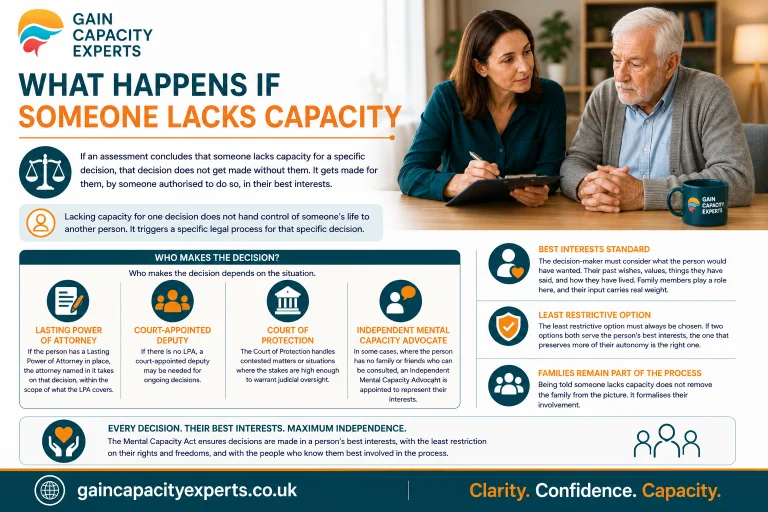
If an assessment concludes that someone lacks capacity for a specific decision, that decision does not get made without them. It gets made for them, by someone authorised to do so, in their best interests.
That distinction matters. Lacking capacity for one decision does not hand control of someone’s life to another person. It triggers a specific legal process for that specific decision.
Who makes the decision depends on the situation. If the person has a Lasting Power of Attorney in place, the attorney named in it takes on that decision, within the scope of what the LPA covers. If there is no LPA, a court-appointed deputy may be needed for ongoing decisions. The Court of Protection handles contested matters or situations where the stakes are high enough to warrant judicial oversight. In some cases, where the person has no family or friends who can be consulted, an Independent Mental Capacity Advocate is appointed to represent their interests.
The best interests standard is not a blank cheque. The decision-maker must consider what the person would have wanted. Their past wishes, values, things they have said, how they have lived. Family members play a role here. Their input on what the person would have chosen, based on knowing them, carries real weight in the process.
The least restrictive option must always be chosen. If two options both serve the person’s best interests, the one that preserves more of their autonomy is the right one.
What families often do not realise is that they remain part of this process. Being told someone lacks capacity does not remove the family from the picture. It formalises their involvement.
If you have received an assessment finding or need guidance on next steps, speak to our specialists. Call 0330 380 2184 or contact Gain Capacity Experts. No obligation. Just clarity.
Can Mental Capacity Change Over Time?
Capacity assessments can change significantly within weeks of the first one, sometimes within days. Delirium is a good example. It can cause acute confusion that looks, from the outside, like a fundamental loss of capacity. Once the underlying cause is treated, the picture changes entirely. The same applies to medication side effects, untreated pain, or the exhaustion that follows a hospital admission. These are temporary states. A good assessor knows the difference between a temporary presentation and a persistent one.
Stroke recovery works on a longer timeline. Swelling reduces. Rehabilitation progresses. Pathways in the brain adapt. Someone assessed as lacking capacity for a financial decision in the acute phase after a stroke may have regained that capacity six months later. The law does not treat the first assessment as final. It expects reassessment when circumstances change.
Dementia is more complex. Capacity may decline over time, but that decline is rarely linear and rarely uniform across all decisions. A person with moderate dementia may still have full capacity to decide where they want to live long after they have lost capacity to manage their finances.
The practical implication is straightforward. If a person’s condition has changed since a previous assessment, or if time has passed and recovery has progressed, a fresh assessment is appropriate. Treating one finding as permanent does not reflect how capacity actually works.
Independent Mental Capacity Assessments in Nottingham and Across England and Wales
Gain Capacity Experts provides independent specialist capacity assessments across England and Wales. That includes Nottingham, the East Midlands, Greater Manchester, and beyond, with home visits and virtual assessments available wherever the person is most comfortable.
Victoria Sample founded the service after more than 20 years working in NHS settings, including secure hospitals and community services for older adults with learning disabilities. It shapes how every assessment is approached. The clinical depth to understand what is happening. The independence to report it without conflict of interest.
The team includes psychiatrists, occupational therapists, social workers, and dementia specialists. Reports are written for legal use from the outset. Whether the matter involves the Court of Protection, an LPA, a contested estate, or a family trying to understand a relative’s situation, the report needs to hold up. That is what the team is built to deliver.
Conclusion
Someone raised the question of capacity. Maybe a solicitor. Maybe a hospital. Maybe you raised it yourself because something felt off and you did not know what to do with that feeling.
You now know what the assessment actually involves. You know it starts from a presumption in the person’s favour. You know it looks at one specific decision, not a general verdict on someone’s life. You know capacity can change, and that a single assessment is never the final word.
If the situation involves a legal matter, a contested decision, or a report that needs to stand up to scrutiny, an independent specialist assessment is the right next step. Not because it is the only option, but because getting it right the first time matters more than most people realise until they are in proceedings and wishing they had.
Get in touch with Gain Capacity Experts. Call 0330 380 2184 to speak with the team directly